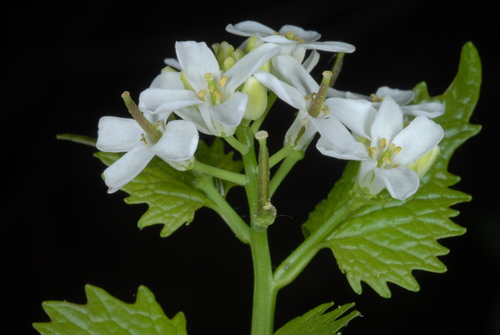
Sisymbrium orientale
L.
Eastern Rocket

(c) Radio Tonreg, some rights reserved (CC BY)

(c) Stefan.lefnaer, some rights reserved (CC BY-SA)

(c) reinderw, some rights reserved (CC BY-NC), uploaded by reinderw
What to Eat
Edible parts: Leaves
The leaves are used in salads.
Where to Find It
It is a temperate plant. In Argentina it grows from sea level to 3,500 m above sea level.
Argentina, Asia, Australia, Britain, Chile, Europe, Ireland, Korea, South America, Spain, Tasmania, Uruguay,
How to Identify
A cabbage family herb. It grows each year from seed. It grows 80 cm tall. It is hairy. The lower leaves have lobes pointing out from the midrib. The upper leaves do not have lobes or can have 3 lobes. The flowers are pale yellow and 5-8 mm across. The seed pods are 5-10 cm long.
Wikipedia
Source ↗Sisymbrium orientale is a species of flowering plant in the family Brassicaceae known by the common names Indian hedgemustard and eastern rocket. It is native to Europe, Asia, and North Africa, and it can be found throughout much of the temperate world as an introduced species and in some areas a common roadside weed. It is an annual herb producing a hairy, branching stem up to about 30 centimeters tall. The basal leaves are divided into deep lobes or toothed leaflets. Leaves higher on the stem have lance-shaped blades with small separate lobes near the base. The top of the stem is occupied by a raceme of flowers with light yellow petals each measuring up to a centimeter long. The fruit is a silique which can be up to 10 centimeters long.
Names & Synonyms
Tamarilla
References (1)
- Blanco-Salas, J., et al, 2019, Wild Plants Potentially Used in Human Food in the Protected Area “Sierra Grande de Hornachos” of Extremadura (Spain). Sustainability 2019, 11, 456