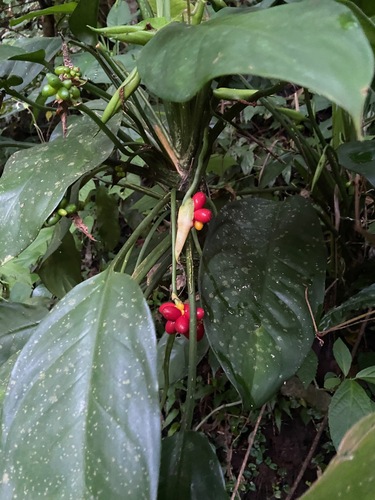
Caladium lindenii
(Andre) Madison
Angel's wings, White vein arrow-leaf

no rights reserved

no rights reserved

no rights reserved
What to Eat
Edible parts: Root, Tuber
The tuber is cooked and eaten.
Known Hazards
Where to Find It
It is a tropical plant. It grows in tropical humid forests and forest floors. It grows near rivers and in damp sites up to 4,500 m above sea level.
Asia, Central America, Colombia*, Indonesia, Panama, SE Asia, South America,
How to Identify
A taro family herb. It grows 60 cm tall. It dies back and re-grows. It has a tuber. The leaves are arrow head shaped and 40 cm long. They are deep green with white veins. There are 1 or 2 flowering shoots up to 25 cm long. The spathe is boat shaped and white. The fruit are along the spadix and are white, fleshy oval berries. They have several seeds.
How to Grow
Plants can be grown from seed or division of the tuber.
Names & Synonyms
Keladi lindeni, Picha de gato, Yautia
References (2)
- Kermath, B. M., et al, 2014, Food Plants in the Americas: A survey of the domesticated, cultivated and wild plants used for Human food in North, Central and South America and the Caribbean. On line draft. p 159
- Sukarya, D. G., (Ed.) 2013, 3,500 Plant Species of the Botanic Gardens of Indonesia. LIPI p 1085