Chiococca alba
(L.) Hitchc.
David's rot, Skunk-root, Snowberry
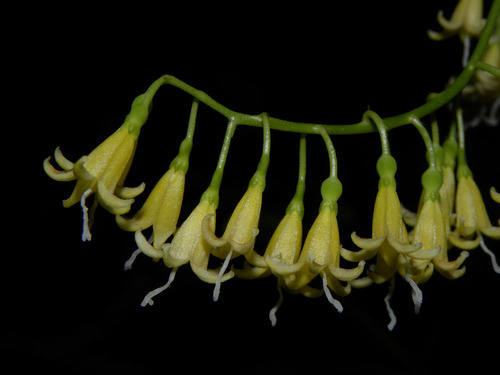
(c) Reinaldo Aguilar, some rights reserved (CC BY-NC-SA)

(c) Neptalí Ramírez Marcial, some rights reserved (CC BY), uploaded by Neptalí Ramírez Marcial

(c) Douglas Goldman, some rights reserved (CC BY-SA), uploaded by Douglas Goldman
What to Eat
Edible parts: Fruit, Roots - tea, Caution
None known
Where to Find It
It grows in the tropics and subtropics.
Argentina, Belize, Bermuda, Brazil*, Caribbean, Central America, Colombia, Costa Rica, Dominican Republic, El Salvador, Guatemala, Haiti, Hispaniola, Honduras, Jamaica, Mexico, Nicaragua, North America, Panama, Paraguay, Puerto Rico, South America, Uruguay, USA, West Indies,
How to Identify
A woody vine or scrambling shrub. It can be 6 m tall. The leaves are opposite and simple. They are 5-11 cm long and oval. The flowers are yellow and bell shaped. They are in groups of 6 to 8. The fruit is white and fleshy. It is 4-7 mm across. There are usually 2 dark brown seeds.
How to Grow
Plants can be grown from seeds. Seedlings grow slowly. Aerial layering and rooted cuttings can be used.
Propagation: Seed.
Medicinal Uses
The herb is used in some regions for treating snake bites. The root is a drastic purgative. More broadly, the roots have been used in herbal medicine as a laxative, diuretic, emetic, and antidiarrhoeal, and the plant was at one time sold commercially in Europe and the United States for those purposes.
Other Uses
Chiococca alba is sometimes cultivated as an ornamental for its dark green, evergreen foliage and white drupes. It is used in espalier and grown on trellises.
Wikipedia
Source ↗Chiococca alba is a species of flowering plant in the coffee family (Rubiaceae) native to Florida and the extreme southern tip of Texas in the United States, Bermuda, Mexico, Central America, the Caribbean, the Galápagos, and tropical South America. Common names include David's milkberry, West Indian milkberry, cahinca and West Indian snowberry. The specific epithet, alba, means "white" in Latin and refers to the color of its fruits.
Names & Synonyms
Acetillo, Arito, Cainana, Cainca, Caninana, Davids milkberry, Frutinha de uru, Perlilla
References (8)
- Brack, P., et al, 2020, Frutas nativas do Rio Grande do Sul, Brasil: riqueza e potencial alimentício. Native fruits of Rio Grande do Sul, Brazil: richness and potential as food. Rodriguésia 71: e03102018
- Grandtner, M. M., 2008, World Dictionary of Trees. Wood and Forest Science Department. Laval University, Quebec, Qc Canada. (Internet database http://www.WDT.QC.ca)
- Grandtner, M. M. & Chevrette, J., 2013, Dictionary of Trees, Volume 2: South America: Nomenclature, Taxonomy and Ecology. Academic Press p 125
- Kermath, B. M., et al, 2014, Food Plants in the Americas: A survey of the domesticated, cultivated and wild plants used for Human food in North, Central and South America and the Caribbean. On line draft. p 220
- Kinupp, V. F., 2007, Plantas alimenticias nao-convencionais da regiao metropolitana de Porto Alegre, RS, Brazil p 97
- Piedra-Malagón, E. M., et al, 2022, Edible native plants of the Gulf of Mexico Province. Biodiversity Data Journal 10: e80565 p 29
- Roa, J. A. G. & Boada, D. S. G., 2018, Fundación para el Fortalecimiento de la Fruticultura y Plantas Alimenticias no Convencionales en Colombia.
- www.colecionandofrutas.org


