Cissus javana
DC.
Begonia Treevine, Mottled cissus

(c) Vijay Anand Ismavel, some rights reserved (CC BY-NC-SA)
(c) Naufal Urfi Dhiya'ulhaq, some rights reserved (CC BY-NC)

(c) Mochammad Imron Afriandi, some rights reserved (CC BY-NC)
What to Eat
Edible parts: Leaves, Fruit
The leaves are eaten raw, added to dishes for a sour flavour, or used for pickles. The ripe red berries are eaten and have a pungent taste.
Where to Find It
A tropical plant. It prefers light to medium, humus rich soil. The soil should be well drained and moist. It suits a shaded and protected position. It is drought and frost tender. Plants need a temperature above 5°C. In Indonesia it grows from sea level to 1,200 m above sea level. In Sichuan and Yunnan.
Andamans, Asia, Australia, China, Hawaii, Himalayas, India, Indochina, Indonesia*, Malaysia, Myanmar, Nepal, Northeastern India, Pacific, Papua New Guinea, PNG, SE Asia, Sikkim, Thailand, USA, Vietnam,
How to Identify
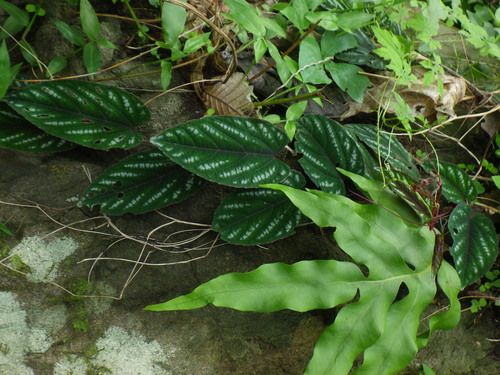
An evergreen vine. It climbs to 3 m high and spreads to 3 m across. The stems are creeping or climbing. They are often red. They have tendrils which attach to objects. The leaves are bright metallic green. The leaves are oval or sword shaped. They are marked with white and purple on the upper surface and are deep red underneath. There are saw like teeth along the edge. The flowers are small and occur in small clusters. The flowers are green with a red tint. The flower clusters are 5 cm long and hang down. The fruit are oval berries which are dark red in colour. They are 8 mm across. They have one seed.
How to Grow
Plants can be grown by seed or cuttings.
Medicinal Uses
The plant (part not specified) is used in the treatment of stomach-aches. A poultice of the leaves or roots is used to treat itches.
Production
In India, plants flower and fruit August to November.
Other Information
It is occasionally cultivated. It is sold in local markets.
Notes
There are about 200-350 Cissus species. There are about 75 species in tropical America.
Names & Synonyms
Aroi beubeureuman, Banteng, Dara, Deras, Jogi lahara, Kam deng, Kangaroo vine, Kongouyen, Lang deng, Mirah, Nag-vel, Rabet dara, Sambang, Sano purenia lahara, Telicha-vel, Telitsa-yel, Teres, Thadavasopu, Vallimaruma
References (26)
- Ambasta, S.P. (Ed.), 2000, The Useful Plants of India. CSIR India. p 126 (As Cissus discolor)
- Arora, R. K., 2014, Diversity in Underutilized Plant Species - An Asia-Pacific Perspective. Bioversity International. p 47
- Bodkin, F., 1991, Encyclopedia Botanica. Cornstalk publishing, p 259 (As Cissus discolor)
- Borrell, O.W., 1989, An Annotated Checklist of the Flora of Kairiru Island, New Guinea. Marcellin College, Victoria Australia. p 146 (As Cissus discolor)
- Brickell, C. (Ed.), 1999, The Royal Horticultural Society A-Z Encyclopedia of Garden Plants. Convent Garden Books. p 270 (As Cissus discolor)
- Burkill, I.H., 1966, A Dictionary of the Economic Products of the Malay Peninsula. Ministry of Agriculture and Cooperatives, Kuala Lumpur, Malaysia. Vol 2 (I-Z) p 2285 (As Vitis discolor)
- Catalogus 39. 1823 (As Cissus discolor)
- Dangol, D. R. et al, 2017, Wild Edible Plants in Nepal. Proceedings of 2nd National Workshop on CUAOGR, 2017.
- Devi, O.S., P. Komor & D. Das, 2010, A checklist of traditional edible bio-resources from Ima markets of Imphal Valley, Manipur, India. Journal of Threatened Taxa 2(11): 1291-1296 (?)
- Facciola, S., 1998, Cornucopia 2: a Source Book of Edible Plants. Kampong Publications, p 245 (As Cissus discolor)
- Ghosh, A, 2014, Survey of Ethno-medicinal Climbing plants in Andaman and Nicobar Islands, India. Int. J. of Pharm. Life Sci. 5(7): July, 2014:3671-3677 (As Cissus discolor)
- Heyne, K., 1927, p 1006 (As Vitis discolor)
- Hibbert, M., 2002, The Aussie Plant Finder 2002, Florilegium. p 67 (As Cissus discolor)
- Kays, S. J., and Dias, J. C. S., 1995, Common Names of Commercially Cultivated Vegetables of the World in 15 languages. Economic Botany, Vol. 49, No. 2, pp. 115-152
- Konsam, S., et al, 2016, Assessment of wild leafy vegetables traditionally consumed by the ethnic communities of Manipur, northeast India. Journal of Ethnobiology and Ethnomedicine, 12:9
- Kumbhojkar, M.S. & Vartak, V.D., 1988, Ethnobotanical Studies on Wild Edible Grapes from Sacred Groves in Western Maharashtra. J. Econ. Tax. Bot. Vol. 12 No. 2 pp 257-263 (As Cissus discolor)
- Martin, F.W. & Ruberte, R.M., 1979, Edible Leaves of the Tropics. Antillian College Press, Mayaguez, Puerto Rico. p 224 (As Cissus discolor)
- Narayanan Ratheesh, M. K. et al, 2011, Wild edible plants used by the Kattunaikka, Paniya and Kuruma tribes of Wayanad District, Kerala, India. Journal of Medicinal Plants Research Vol. 5(15), pp. 3520-3529 (As Cissus discolor)
- Ochse, J. J. et al, 1931, Vegetables of the Dutch East Indies. Asher reprint. p 726 (As Cissus discolor)
- Savita, et al, 2006, Studies on wild edible plants of ethnic people in east Sikkim. Asian J. of Bio Sci. (2006) Vol. 1 No. 2 : 117-125 (As Cissus discolor)
- Singh, H.B., Arora R.K.,1978, Wild edible Plants of India. Indian Council of Agricultural Research, New Delhi. p 22 (As Cissus discolor)
- Staples, G.W. and Herbst, D.R., 2005, A tropical Garden Flora. Bishop Museum Press, Honolulu, Hawaii. p 572 (As Cissus discolor)
- Uprety, Y., et al, 2012, Diversity of use and local knowledge of wild edible plant resources in Nepal. Journal of Ethnobotany and Ethnomedicine 8:16
- Vartak, V.D. and Kulkarni, D.K., 1987, Monsoon wild leafy vegetables from hilly regions of Pune and neighbouring districts, Maharashtra state. J. Econ. Tax. Bot. Vol. 11 No. 2 pp 331-335 (As Cissus discolor)
- World Checklist of Useful Plant Species 2020. Royal Botanic Gardens, Kew (As Cissus discolor)
- Xu, Z., Tao, G. & Tan J., 1988, Tropical Wild Flowers and Plants in Xishuangbanna, Agricultural Publishing House. photo 117 (As Cissus discolor)


