Protium spruceanum
(Benth.) Engl.
Spruce resin tree
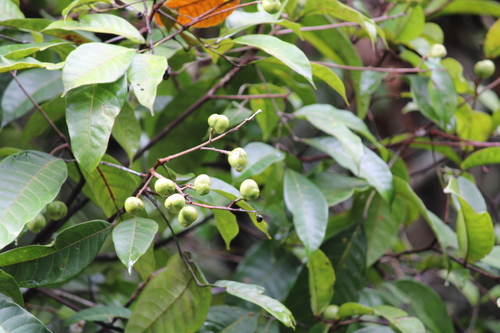
(c) KATELL UGUEN, some rights reserved (CC BY-SA), uploaded by KATELL UGUEN

Wikimedia Commons - João Medeiros

Wikimedia Commons - João Medeiros
What to Eat
A succulent, sweet-tasting aril surrounds the seed. This report does not say that the fruit is edible, but it is likely to be since several other members of the genus have edible fruits. It is rather small though, the red, globose fruits are only 15mm in diameter.
Where to Find It
S. America - Brazil, Bolivia, Peru, Ecuador, Colombia, Venezuela.
Fruit - aril,
How to Identify
Protium spruceanum is an aromatic, semideciduous tree with a dense, roundish crown; it can grow 8 - 14 metres tall. The straight, cylindrical bole can be 25 - 40cm in diameter. The tree is sometimes harvested from the wild for its wood, which is used locally. A very ornamental plant that can be used in landscaping.
How to Grow
Prefers a shady position. A fast-growing plant. Most, if not all, species in this genus are dioecious, both male and female forms need to be grown if fruit and seed are required.
Propagation: Seed - best sown as soon as it is ripe in a partially shaded position in a nursery seedbed. A germination rate of less than 50% can be expected, with the seed sprouting within 20 - 35 days. When the seedlings are 5 - 6cm tall, pot them up into individual containers and they should be ready to plant out 7 - 8 months later.
Other Uses
We have no specific information for this species, but many members of this genus are valued for the whitish and fragrant resin (suggesting incense) that exudes freely from the bark, and which hardens upon exposure to the air. The wood is medium-textured, straight-grained, moderately heavy, with moderate mechanical properties and moderately durable. It is used in general construction to make items such as beams, lathes, door and window frames etc, for light cabinet making, frames etc. The wood is used for fuel and to make charcoal.
Other Information
Burseraceae
Notes
A tree.
Names & Synonyms
Aliso, Almecegueira, Amescla-branca, Anime, Ayawaco, Breu, Breu-branco, Catacamaja, Kandei'y, Tucumajaco
References (3)
- Grandtner, M. M. & Chevrette, J., 2013, Dictionary of Trees, Volume 2: South America: Nomenclature, Taxonomy and Ecology. Academic Press p 539
- Kermath, B. M., et al, 2014, Food Plants in the Americas: A survey of the domesticated, cultivated and wild plants used for Human food in North, Central and South America and the Caribbean. On line draft. p 707
- Roa, J. A. G. & Boada, D. S. G., 2018, Fundación para el Fortalecimiento de la Fruticultura y Plantas Alimenticias no Convencionales en Colombia.


