Ribes missouriense
Nutt.
Missouri gooseberry

(c) Jared Belsky, some rights reserved (CC BY-NC)
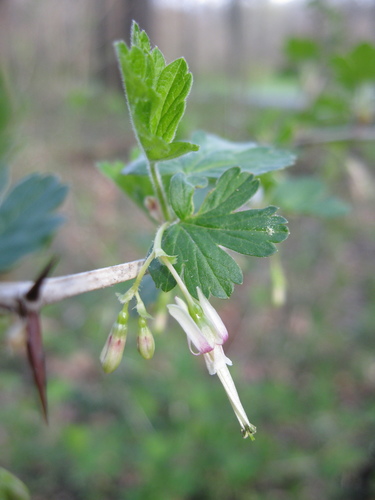
(c) sequoia_, some rights reserved (CC BY-NC), uploaded by sequoia_

(c) Jared Belsky, some rights reserved (CC BY-NC)
What to Eat
Edible parts: Fruit, Leaves, Leaves - tea
The fruit can be eaten raw or cooked and has a rich, sub-acid, vinous flavour that is very agreeable. It is somewhat too acid for most people to enjoy raw but makes delicious tarts when fully ripe. The fruit can also be dried for later use. This smooth-skinned gooseberry is typically about 10mm in diameter, though some forms reach up to 14mm.
Where to Find It
It is a temperate plant.
North America, USA*,
How to Identify
A gooseberry. It is a bush. The leaves have lobes. The stems have spines at the nodes. The flowers are white.
How to Grow
Easily grown in a moisture retentive but well-drained loamy soil of at least moderate quality. Plants are quite tolerant of shade though do not fruit so well in such a position. Hardy to about -20°c. Plants can harbour a stage of 'white pine blister rust', so they should not be grown in the vicinity of pine trees. Plants in this genus are notably susceptible to honey fungus. Widely cultivated in temperate areas for its edible fruit, there are many named varieties.
Propagation: Seed is best sown as soon as it is ripe in autumn in a cold frame. Stored seed requires 3 months of cold stratification at 0–5°c and should be sown as early in the year as possible. Under normal storage conditions seed can remain viable for 17 years or more. Prick out seedlings into individual pots when large enough to handle, grow on in a cold frame through their first winter, then plant out in late spring the following year. Cuttings of half-ripe wood, 10–15cm with a heel, taken July/August in a frame. Cuttings of mature wood of the current year's growth, preferably with a heel of the previous year's growth, taken November to February in a cold frame or sheltered bed outdoors.
Medicinal Uses
None known
Other Uses
None known
Wikipedia
Source ↗Ribes missouriense, the Missouri gooseberry, Missouri currant or wild gooseberry, is a prickly, many-stemmed shrub native to the north-central United States (Great Lakes, upper Mississippi and lower Missouri Valleys). Scattered populations have been found further east, most of them likely escapes cultivation. The Missouri gooseberry was once common as far east as Ohio, but was nearly extirpated there during the 19th and 20th centuries (partly due to early 20th-century efforts to prevent the spread of white pine blister rust by removing as many Ribes hosts as possible). Since 1982, however, the Missouri gooseberry has been granted protected status as an endangered species in Ohio, It is also endangered in New Jersey and Pennsylvania.
Other Information
It is a cultivated food plant.
Names & Synonyms
References (4)
- Fisk, J. R. & Hoover, E., 2015, Wild Fruits of Minnesota. A Field Guide. University of Minnesota p 16
- Kermath, B. M., et al, 2014, Food Plants in the Americas: A survey of the domesticated, cultivated and wild plants used for Human food in North, Central and South America and the Caribbean. On line draft. p 747
- Toupal, R. S. & Hollenback, K., 2009, An Ethnobotany of Indiana Dunes National Lakeshore: Plant Uses of the Ojibwa People. Bureau of Applied Research in Anthropology. University of Arizona
- Wild Edible Plants of the Whitmire Wildflower Garden. Missouri Botanical garden.
More from Grossulariaceae


