Cissus producta
Afzel.
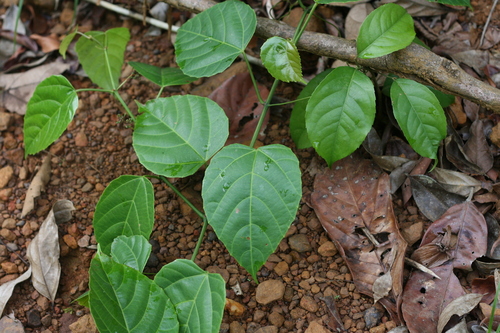
(c) Luc Strydom, some rights reserved (CC BY-NC), uploaded by Luc Strydom
What to Eat
Edible parts: Leaves, Vegetable
Leaves - cooked and eaten as a vegetable. An acid flavour, somewhat like sorrel (Rumex spp.). The cut stems exude a considerable amount of potable water.
Where to Find It
A tropical plant. It grows in the forest. In Malawi it grows along the shores of the lake and near streams. It grows up to 1.050 m above sea level.
Africa, Angola, Benin, Burkina Faso, Cameroon, Central Africa, Congo, Côte d'Ivoire, East Africa, Equatorial-Guinea, Gabon, Ghana, Guinea, Guinée, Guinea-Bissau, Ivory Coast, Malawi, Nigeria, Sao Tome and Principe, Senegal, Sierra Leone, Southern Africa, Sudan, Tanzania, Togo, Uganda, West Africa, Zambia, Zimbabwe,
How to Identify
A small creeper. It arises from a tuberous rootstock. The stems are square. There are a few hairs. It has tendrils. The leaves are simple. The leaf blade is 10 cm long by 6 cm wide. They are oval and have some teeth near the ends. The flowering stalks are 4-10 cm long and opposite the leaves. The flowers are pink. The fruit are black or red and 1.5 cm long by 1 cm wide. There is one seed about 13 mm long by 8 mm wide.
Medicinal Uses
The ripe fruits are rubbed on the forehead or are crushed and tied around the forehead to treat headache. The plant (part not specified) is considered a cure for gonorrhoea.
Other Uses
An emulsion of the roots is used to protect cows from bites of tsetse flies. The emulsion is applied by rubbing on the skin or by internal dosing.
Notes
There are about 200-350 Cissus species. There are about 75 species in tropical America.
Names & Synonyms
Bu telen, Tomboro porane
References (11)
- Burkill, H. M., 1985, The useful plants of west tropical Africa, Vol. 5. Kew.
- Busson, 1965,
- Dalziel, J. M., 1937, The Useful plants of west tropical Africa. Crown Agents for the Colonies London.
- Flora Zambesiaca. http://apps.kew.org/efloras
- Fowler, D. G., 2007, Zambian Plants: Their Vernacular Names and Uses. Kew. p 85
- Grubben, G. J. H. and Denton, O. A. (eds), 2004, Plant Resources of Tropical Africa 2. Vegetables. PROTA, Wageningen, Netherlands. p 184
- Martin, F.W. & Ruberte, R.M., 1979, Edible Leaves of the Tropics. Antillian College Press, Mayaguez, Puerto Rico. p 224
- Peters, C. R., O'Brien, E. M., and Drummond, R.B., 1992, Edible Wild plants of Sub-saharan Africa. Kew. p 201
- Raponda-Walker, A & Sillans, R., 1961, Les Plantes Utiles du Gabon. Editions Paul Lechevalier, Paris. p 55
- White, F., Dowsett-Lemaire, F. and Chapman, J. D., 2001, Evergreen Forest Flora of Malawi. Kew. p 598
- World Checklist of Useful Plant Species 2020. Royal Botanic Gardens, Kew


