Plectranthus scutellarioides
(L.) R. Br
Flame nettle, Painted leaves, Painted nettle, Butterfly coleus
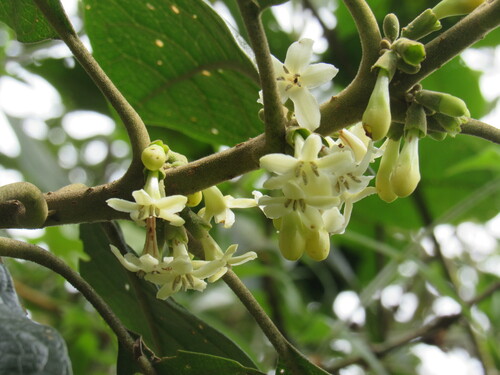
(c) Babajide Agboola, some rights reserved (CC BY-NC)

(c) Babajide Agboola, some rights reserved (CC BY-NC)

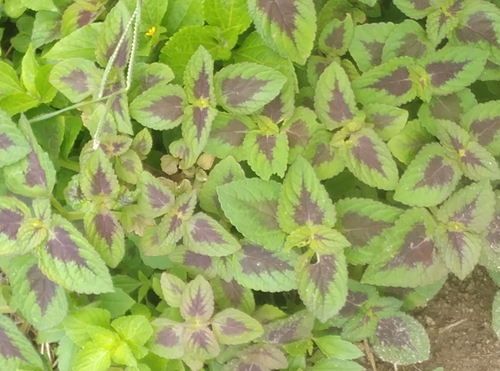
(c) 朱申捷, some rights reserved (CC BY-NC)
What to Eat
Edible parts: Leaves, Tubers, Root
Young leaves are eaten as a seasoning, traditionally served with bread and butter. Tubers and roots are also eaten.
Known Hazards
Where to Find It
A tropical plant. It suits tropical and subtropical places. It can grow from the lowlands to the mountains. It can be in rainforest and along shaded stream banks. It grows up to 2,900 m above sea level. It often grows near water, such as the edges of swamps or streams. It suits hardiness zones 10-12. Coffs Harbour Botanical Gardens.
Africa, Asia, Australia, Cambodia, Central America, China, Costa Rica, Dominican Republic, Fiji, Hawaii, India, Indochina, Indonesia, Kiribati, Laos, Malaysia, Marquesas, New Caledonia, Pacific, Papua New Guinea, PNG, Philippines, Rotuma, Samoa, SE Asia, Solomon Islands, Taiwan, Thailand, Tuvalu, USA, Vanuatu, Vietnam, West Indies,
How to Identify
A herb up to 50 cm high and covered with hairs. It spreads to 30 cm across. The stems and branches are square. They are usually purple. The leaves are opposite. The leaf stalks are 1-4 cm long. The leaves are 3-7 cm long by 1.5-5 cm wide. They are oval or sword shaped. The edges of the leaves are toothed. The leaves have a smell when crushed. The leaves can be dark red, purple, or green and hairy. The flower clusters are erect and at the end of the shoots. The flowers are 5 mm long. They are purple or bluish. The nutlets are brown and broadly oval. They are 1-1.2 mm long. They are shiny.
How to Grow
It grows readily from cuttings. It also grows wild from seed. Seeds germinate easily.
Propagation: Seed - sow in well-drained soil, covering lightly with a thin layer of sand, and place in a warm but shaded spot. The seed germinates in about three weeks. Cuttings of Plectranthus species generally root easily - soft tips root faster than semi-hardwood growth. The cuttings are best taken 60 - 100mm long with three or four nodes, making the cut just below a node. Place them in sand, perlite, vermiculite or peat, or any mixture of these, keep them moist and shaded and they should root in 2 - 3 weeks
Medicinal Uses
Traditional uses documented in ethnobotanical sources, though specific medicinal applications are not detailed in available data.
Other Uses
The sap from the leaves of the wild, purple-black species is used in tattooing. The plant is used as a living fence in coffee plantations.
Other Information
It is occasionally harvested from the wild.
Notes
It is widely grown for its ornamental leaves.
Names & Synonyms
Ati-ati, Buiara, Coleus, Iler, Jacob's coat. Jawer kotok, Mayana, Miana, Oloveti, Pate, Patiale, Rue-sii-phasomlaeo, Sayabana, Tia to canh, Wu cai su
References (22)
- Bothalia 11:439. 1975 [As (L.) Codd] (As Solenostemon scutellarioides)
- Cabalion, P. and Morat, P., 1983, Introduction le vegetation, la flore et aux noms vernaculaires de l'ile de Pentcoste (Vanuatu), In: Journal d'agriculture traditionnelle et de botanique appliquee JATBA Vol. 30, 3-4 (As Coleus scutellarioides)
- Cundall, P., (ed.), 2004, Gardening Australia: flora: the gardener's bible. ABC Books. p 1350 (As Solenostemon scutellarioides)
- Elliot, W.R., & Jones, D.L., 1984, Encyclopedia of Australian Plants suitable for cultivation. Vol 3. Lothian. p 58 (As Coleus scutellarioides)
- Engel, D.H., & Phummai, S., 2000, A Field Guide to Tropical Plants of Asia. Timber Press. p 231 (As Solenostemon scutellarioides)
- Facciola, S., 1998, Cornucopia 2: a Source Book of Edible Plants. Kampong Publications, p 125 (As Coleus blumei)
- Fern, K., 2012, Tropical Species Database http://theferns.info/tropical/
- French, B.R., 1986, Food Plants of Papua New Guinea, A Compendium. Asia Pacific Science Foundation p 333 (As Coleus scutellarioides)
- Kermath, B. M., et al, 2014, Food Plants in the Americas: A survey of the domesticated, cultivated and wild plants used for Human food in North, Central and South America and the Caribbean. On line draft. p 827 (As Solenostemon scutellarioides)
- Lawton, B.P., 2002, Mints. A Family of Herbs and Ornamentals. Timber Press. p 201 (As Solenostemon scutellarioides)
- Liefting, A., et al, Samoan plant names. http://en.wikipedia.org (As Coleus)
- Li Hai-wen, Hedge, I.C., Lamiaceae. Flora of China. p 390 (As Coleus scutellarioides)
- Lim, T. K., 2015, Edible Medicinal and Non Medicinal Plants. Volume 9, Modified Stems, Roots, Bulbs. Springer p 26
- Paczkowska, G. & Chapman, A.R., 2000, The Western Australian Flora. A Descriptive Catalogue. Western Australian Herbarium. p 276 (As Solenostemon scutellarioides)
- Parham, B. E. V., 1972, Plants of Samoa. New Zealand Department of Scientific and Industrial Research. Information Series. No. 85 p 98 (As Coleus scutellarioides)
- Powell, J.M., Ethnobotany. In Paijmans, K., 1976, New Guinea Vegetation. Australian National University Press. p 109 (As Coleus scutellarioides)
- Smith, A.C., 1991, Flora Vitiensis Nova, Lawaii, Kuai, Hawaii, Volume 5 p 220 (As Solenostemon scutellarioides)
- Staples, G.W. and Herbst, D.R., 2005, A tropical Garden Flora. Bishop Museum Press, Honolulu, Hawaii. p 364 (As Solenostemon scutellarioides)
- Sukarya, D. G., (Ed.) 2013, 3,500 Plant Species of the Botanic Gardens of Indonesia. LIPI p 1131
- Thaman, R. R., 1987, Plants of Kiribati: A listing and analysis of vernacular names. Atoll Research Bulletin No. 296
- Thaman, R. R, 2016, The flora of Tuvalu. Atoll Research Bulletin No. 611. Smithsonian Institute p 95
- World Checklist of Useful Plant Species 2020. Royal Botanic Gardens, Kew