Randia calycina
Cham.
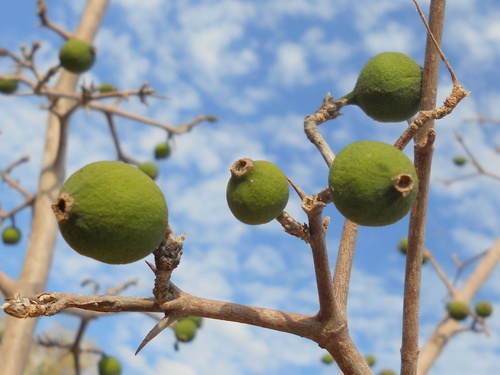
(c) Lucas C. Marinho, some rights reserved (CC BY-NC), uploaded by Lucas C. Marinho

(c) Víctor de Paiva, some rights reserved (CC BY-NC-ND), uploaded by Víctor de Paiva

(c) Víctor de Paiva, some rights reserved (CC BY-NC-ND), uploaded by Víctor de Paiva
What to Eat
Edible parts: Fruit
The fruit are eaten and have a chocolate or coffee flavor.
Where to Find It
It is a tropical plant. It grows in the rainforest in the Amazon. It is recorded up to 1,000 m above sea level. It grows in acid soils.
Bolivia, Brazil, Colombia, Ecuador, Guyana, Paraguay, Peru, South America,
How to Identify
A shrub. It grows 2-4 m tall. It has thorns about 1 cm long. The trunk is grey and branched. It is 6 cm across. The tree loses its leaves. The leaves are opposite and papery. They are oval and 6-11 cm long by 3-5 cm wide. The base is wedge shaped and there is a coating on the upper surface. The male flowers are in groups of 4-6 and female flowers as 1 or 2 together. The fruit are oblong and yellow or back when ripe. There is a coffee coloured layer over the flat seeds.
How to Grow
Plants can be grown from seeds. Seeds germinate after 35-85 days. Plants can be put in a nursery and then transplanted. A spacing of 3-4 m is suitable.
Production
In Brazil plants fruit June to July.
Names & Synonyms
Espino, Guaticuruzu-mirim, Limoncillo, Manzanita
References (3)
- Grandtner, M. M. & Chevrette, J., 2013, Dictionary of Trees, Volume 2: South America: Nomenclature, Taxonomy and Ecology. Academic Press p 561
- Roa, J. A. G. & Boada, D. S. G., 2018, Fundación para el Fortalecimiento de la Fruticultura y Plantas Alimenticias no Convencionales en Colombia.
- www.colecionandofrutas.org


