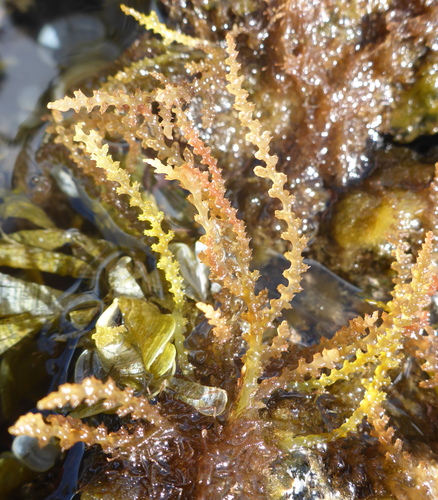
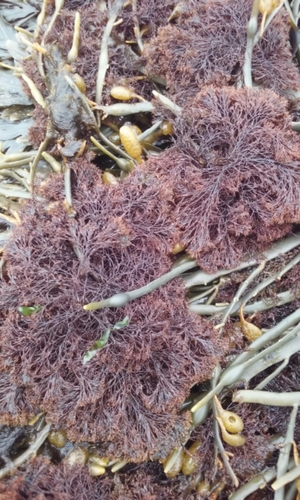
Vertebrata lanosa
(Linnaeus) T. A. Christensen
iNaturalist · cc-by-nc
(c) libby_orcutt, some rights reserved (CC BY-NC), uploaded by libby_orcutt
(c) libby_orcutt, some rights reserved (CC BY-NC), uploaded by libby_orcutt

iNaturalist · cc0
no rights reserved
no rights reserved
What to Eat
Edible parts: Algae, Seaweed
The seaweed is edible.
Where to Find It
It is a temperate plant.
Europe, Iceland, Norway, Scandinavia,
Countries: Andorra, Albania, Austria, Bosnia & Herzegovina, Belgium, Bulgaria, Belarus, Switzerland, Cyprus, Czechia, Germany, Denmark, Estonia, Spain, Finland, France, United Kingdom, Greece, Croatia, Hungary, Ireland, Iceland, Italy, Liechtenstein, Lithuania, Luxembourg, Latvia, Monaco, Moldova, Montenegro, North Macedonia, Malta, Netherlands, Norway, Poland, Portugal, Romania, Serbia, Russia, Sweden, Slovenia, Slovakia, San Marino, Ukraine
How to Identify
A temperate seaweed belonging to the Rhodomelaceae family.
Nutrition Score: 3/100
| Part | Moisture | kJ | kcal | Protein | Vit A | Vit C | Iron | Zinc |
|---|---|---|---|---|---|---|---|---|
| Seaweed | — | — | 11.6 | — | — | — | — | — |
Names & Synonyms
Grisetangdokke
Fucus lanosa L.
References (3)
- Cherry, P., et al, 2019, Risks and benefits of consuming edible seaweeds. Nutrition ReviewsVR Vol. 77(5):307–329
- Girard, N. J., 2020, Sustainable Foraging of Wild Edible Plants in Norway. A Biocultural Approach. M. Sc. thesis Norwegian University. p 134
- Pereira, L., Edible Seaweeds of the World. CRC Press.