Combretum imberbe
Wawra
Leadwood, Ivory tree

(c) Troos van der Merwe, some rights reserved (CC BY-NC), uploaded by Troos van der Merwe
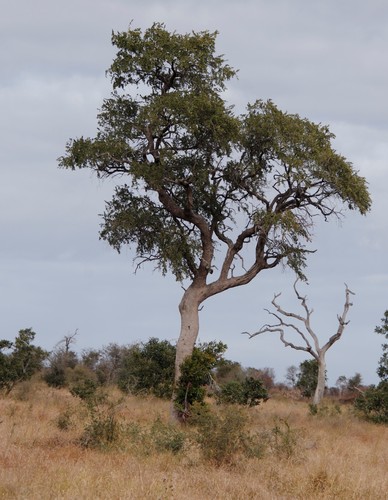
(c) Tony Rebelo, some rights reserved (CC BY-SA), uploaded by Tony Rebelo

(c) Troos van der Merwe, some rights reserved (CC BY-NC), uploaded by Troos van der Merwe
What to Eat
Edible parts: Gum, Leaves, Fruit - gum
The tree produces an edible gum of medium quality that is reasonably clear. The leaves and fruit are also edible.
Where to Find It
A tropical plant. It is usually on good soils. It grows in woodland and along streams. It grows at medium to low altitudes. It is often in mixed woodlands and along rivers. It especially grows in alluvial soils. It grows between 185-1,650 m above sea level. It can grow in salty soils. It can grow in arid places. Brisbane Botanical Gardens.
Africa, Angola, Australia, Botswana, Central Africa, East Africa, Eswatini, Malawi, Mozambique, Namibia, South Africa, Southern Africa, Swaziland, Tanzania, Zambia, Zimbabwe,
How to Identify
A tall tree which loses its leaves during the year. It can be 21 m tall. The trunk can be 1 m across. The bark cracks in rectangular flakes. The wood is very hard. The young branches and twigs often have hard spines. The leaves are simple and opposite. They are 2.5-4 cm long by 0.8-3.5 cm wide. They are oblong. The base is narrow and the edges are wavy. They are silvery grey and with red scales. The flowers are yellow in loose spikes in the axils of leaves and near the ends of branches. The fruit are 1.9 cm across and with 4 wings. They are yellowish-green but can have a red tinge.
Nutrition Score: 43/100
| Part | Moisture | kJ | kcal | Protein | Vit A | Vit C | Iron | Zinc |
|---|---|---|---|---|---|---|---|---|
| Gum | 11.4 | 1371 | 328 | 1.3 | — | — | 3.9 | 0.5 |
How to Grow
A tropical plant. Plants are not tolerant of frosts. Grows best in a sunny position and a well-drained soil. Established trees are fairly drought resistant. A very slow growing tree. Under natural conditions, mean annual diameter increment rates of only 0.3 mm to 2 mm have been recorded, but under optimal conditions in cultivation young trees may reach 6 m tall in 15 years. The trees can become very old. Radiocarbon dating showed that some specimens were over 1,000 years old. Dead trees can remain upright for as much as 80 years.. Trees respond well to coppicing. The number of shoots produced from cut stems is negatively correlated with the height at which the trees are cut, but shorter shoots are produced when the tree is cut close to the ground. A cutting height of 1 metre appears most advantageous.
Propagation: Seed is best sown fresh. Pre-soak in warm water for a few hours, then press seeds into seedling trays filled with river sand, cover with a thin layer of sand, and keep moist. Germination occurs within 1–2 weeks, though very low germination rates of 3–5% have been recorded, along with high seedling mortality. Seedlings can be transplanted into nursery bags after the second leaf develops. Seed stored inside the fruit retains viability for several years in most if not all species.
Medicinal Uses
Several parts of the plant are used in traditional medicine. Powdered roots or leaves, and decoctions made from them, are taken internally to treat stomach aches, diarrhoea, coughs, colds, and chest pains. A leaf decoction is applied as an enema to relieve constipation. Smoke from burnt leaves is inhaled to treat coughs, colds, and chest complaints. The roots are used to treat infertility in women. An infusion is drunk to treat schistosomiasis. Bark powder is applied externally against leprosy. Flowers are used to prepare a cough medicine. Acetone and ethyl acetate extracts of the leaves have shown pronounced anti-inflammatory activity in testing. An aqueous leaf extract has shown activity against Schistosoma haematobium. The pentacyclic triterpene imberbic acid, isolated from the leaves, has demonstrated potent antibacterial activity against Mycobacterium fortuitum and Staphylococcus aureus.
Other Uses
The wood ash has a high lime content and is used as toothpaste and as a whitewash substitute for decorating house walls. Testing has shown wood ash to be effective at managing cowpea weevils in stored cowpea seeds. The bark yields tannins. The heartwood is dark brown, clearly distinct from the thin yellow-brown sapwood, with a straight grain and fine texture. The wood is very heavy and extremely durable, even in ground contact, and highly resistant to termites. It is difficult to work, blunting cutting edges rapidly, but takes an excellent lustrous polish and has outstanding turning properties. Uses include fence poles, mine props, railway sleepers, mortars, walking sticks, inlay work, toys, turnery, sculpture, lathe work, the main supporting poles of huts, and heavy, extremely durable furniture. The wood is also valued as fuel and for charcoal production, burning slowly and with great heat.
Wikipedia
Source ↗Combretum imberbe (also known as leadwood or mhoba-hoba, Afrikaans: hardekool, Sotho: mohwelere-tšhipi, Tsonga: motswiri/mondzo, Zulu: impondondlovu) is a characteristic and often impressive bushwillow species of the southern Afrotropics. The medium to large tree has a sparse, semi-deciduous canopy of grey-green leaves. The twigs and leaves are hairless as the name imberbe suggests. Its heartwood is dark brown, close-grained, very hard and heavy, as suggested by its vernacular name "leadwood", and durable; it is much sought after in the woodcarving industry. The Hereros and Ovambos of Namibia attach special cultural and religious significance to the tree, as to them it is the great ancestor of all animals and people, which must be passed with respect.
Production
It is a slow growing tree. It grows about 8 cm in one year. Trees can live for 1,000 years.
Notes
There are about 255 Combretum species.
Names & Synonyms
Hardekool, Impondozendhlovu, Lipholovu lendlovu, Loodhout, Mgodo, Mkolongonjo, Mnangali, Mocoza, Monzo, Motswere, Motswiri, Msimbiti, Muando, Muchenarota, Mukotama, Munangar, Munyondo, Mutsviri, Omukuku, Omumborongbon, Umtshenalotha, Umtshwili
References (23)
- Fowler, D. G., 2007, Zambian Plants: Their Vernacular Names and Uses. Kew. p 19
- Fox, F. W. & Young, M. E. N., 1982, Food from the Veld. Delta Books. p 157
- Grivetti, 1976, 1979,
- Grivetti, L. E., 1980, Agricultural development: present and potential role of edible wild plants. Part 2: Sub-Saharan Africa, Report to the Department of State Agency for International Development. p 79
- Lee, 1979,
- Long, C., 2005, Swaziland's Flora - siSwati names and Uses http://www.sntc.org.sz/flora/
- Mannheimer, C. A. & Curtis. B.A. (eds), 2009, Le Roux and Muller's Field Guide to the Trees and Shrubs of Namibia. Windhoek: Macmillan Education Namibia. p 360
- Palgrave, K.C., 1996, Trees of Southern Africa. Struik Publishers. p 669
- Palmer, E and Pitman, N., 1972, Trees of Southern Africa. Vol. 3. A.A. Balkema, Cape Town p 1651
- Peters, C. R., O'Brien, E. M., and Drummond, R.B., 1992, Edible Wild plants of Sub-saharan Africa. Kew. p 86
- Plowes, N. J. & Taylor, F. W., 1997, The Processing of Indigenous Fruits and other Wildfoods of Southern Africa. in Smartt, L. & Haq. (Eds) Domestication, Production and Utilization of New Crops. ICUC p 188
- Rodin, 1985,
- Royal Botanic Gardens, Kew (1999). Survey of Economic Plants for Arid and Semi-Arid Lands (SEPASAL) database. Published on the Internet; http://www.rbgkew.org.uk/ceb/sepasal/internet [Accessed 10th April 2011]
- Ruiters-Welcome, A. K., 2019, Food plants of southern Africa. Ph.D. thesis. Univ. of Johannesburg p 45
- Sitzungsber. Kaiserl. Acad. Wiss. Wien, Math.-Naturwiss. Cl. 38:556. 1860
- Swaziland's Flora Database http://www.sntc.org.sz/flora
- van Wyk, B, van Wyk, P, and van Wyk B., 2000, Photographic guide to Trees of Southern Africa. Briza. p 91
- Venter, F & J., 2009, Making the most of Indigenous Trees. Briza. p 108
- Wehmeyer, A. S, 1986, Edible Wild Plants of Southern Africa. Data on the Nutrient Contents of over 300 species
- Welcome, A. K. & Van Wyk, B.-E., 2019, An inventory and analysis of the food plants of southern Africa. South African Journal of Botany 122 (2019) 136–179
- Williamson, J., 2005, Useful Plants of Malawi. 3rd. Edition. Mdadzi Book Trust. p 75
- World Checklist of Useful Plant Species 2020. Royal Botanic Gardens, Kew
- www.zimbabweflora.co.zw 2011


