Combretum paniculatum
Vent.
Flame combretum, Burning-bush combretum
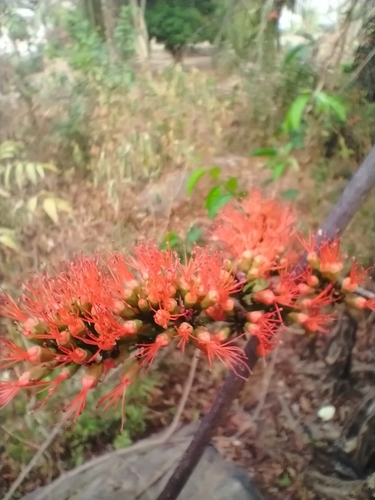
(c) Babajide Agboola, some rights reserved (CC BY-NC), uploaded by Babajide Agboola
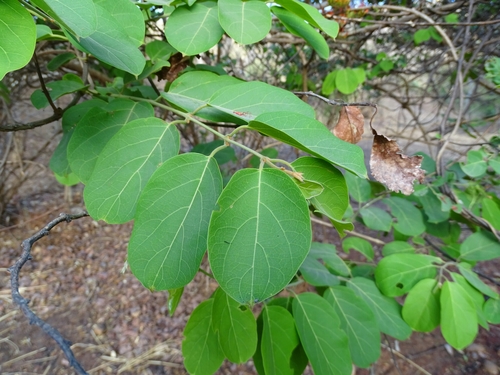
(c) AMADOU BAHLEMAN FARID, some rights reserved (CC BY-NC), uploaded by AMADOU BAHLEMAN FARID

(c) Rob Palmer, some rights reserved (CC BY-NC-SA), uploaded by Rob Palmer
What to Eat
Edible parts: Leaves, Nectar, Flowers, Stem sap, Vegetable
The leaves are added to soups and used as a potherb. The stem sap is drunk as a beverage, and the flowers are sucked by children.
Known Hazards
Where to Find It
A tropical plant. It grows in areas of high rainfall on the edges of evergreen forest. It also grows in savannah woodland. In Malawi it grows between 600-1,600 m altitude. It is damaged by drought and frost. It can tolerate flooding. It can grow in arid places.
Africa*, Angola, Australia, Benin, Burkina Faso, Cameroon, Central Africa, Central African Republic, CAR, Congo DR, Côte d'Ivoire, East Africa, Eswatini, Ethiopia, Gabon, Gambia, Ghana, Guinea, Guinée, Guinea-Bissau, Ivory Coast, Kenya, Liberia, Malawi, Mozambique, Niger, Nigeria, Sahel, Sao Tome and Principe, Senegal, Sierra Leone, South Africa, Southern Africa, Swaziland, Tanzania, Uganda, West Africa, Zimbabwe,
How to Identify
It is usually a vigorous climber or scrambling bush. It can be a small tree 3-4 m high. The bark is grey to pale brown. The leaves are opposite and oval. They are 18 cm long by 9.5 cm wide. They are thinly leathery. They are glossy dark green but paler underneath. The veins are yellow and like a net. The base has shallow lobes. The leaf stalk is 3 cm long. The flowers are bright red with very red stamens. The petals are 2.5 mm across. The flowers are in small clusters but the large number along the stem create a showy display. The fruit are 4 winged. They are 2 cm across. They are pink or red when young and dry to a pale brown.
How to Grow
It can be grown by seeds or cuttings.
Medicinal Uses
An infusion of roots, leaves and stems is used as a garli medicine. Garli (Fula) is a condition of 'stomach staggers' affecting all cattle. The tomentum off the leaves is taken in draught to prevent vomiting. The leaf-sap is applied externally in the treatment of gonorrhoea. Leaves that have had galls on them are ground up with salt and the paste is applied to the tongue and inside the mouth of babies with stomatitis. A decoction of galled leaves is used in hipbaths and vaginal douches for the trreatment of haemorrhoids. The roots, crushed with a pimento, are used as an enema to treat haemorrhoids. An aqueous decoction of the roots is used as a treatment for diarrhoea, stomach-ache, gonorrhoea and fever. The sap expressed from freshly ground-up flowers is used to treat conjunctivitis and other eye-troubles. The aqueous extract of the inflorescence has shown some action against carcinomous tumours.
Other Uses
The stems are used to make a rope, to weave into winnowing baskets, whilst the stems and roots are used to tie up beehives. The wood is said to be good for implement-handles.
Wikipedia
Source ↗Combretum paniculatum, the burning bush or forest flame-creeper, is a plant species in the genus Combretum found in Africa. The fruit is a samara, i.e. a winged seed.
Other Information
The flowers are sucked by children.
Notes
There are about 255 Combretum species.
Names & Synonyms
Akoti, Bambagwena, Bayie, Mupfurura, N'kambam, Omeha
References (25)
- Abbiw, D.K., 1990, Useful Plants of Ghana. West African uses of wild and cultivated plants. Intermediate Technology Publications and the Royal Botanic Gardens, Kew. p 42
- Bodkin, F., 1991, Encyclopedia Botanica. Cornstalk publishing, p 274
- Brickell, C. (Ed.), 1999, The Royal Horticultural Society A-Z Encyclopedia of Garden Plants. Convent Garden Books. p 290
- Burkill, H. M., 1985, The useful plants of west tropical Africa, Vol. 1. Kew.
- Busson, 1965,
- Choix pl. ad t. 58. 1808
- Codjia, J. T. C., et al, 2003, Diversity and local valorisation of vegetal edible products in Benin. Cahiers Agricultures 12:1-12
- Dalziel, J. M., 1937, The Useful plants of west tropical Africa. Crown Agents for the Colonies London.
- Food Composition Tables for use in Africa FAO http://www.fao.org/infoods/directory No. 591
- Gallagher, D. E., 2010, Farming beyond the escarpment: Society, Environment, and Mobility in Precolonial Southeastern Burkina Faso. PhD University of Michigan.
- Grubben, G. J. H. and Denton, O. A. (eds), 2004, Plant Resources of Tropical Africa 2. Vegetables. PROTA, Wageningen, Netherlands. p 560
- Jardin, C., 1970, List of Foods Used In Africa, FAO Nutrition Information Document Series No 2.p 69
- Martin, F.W. & Ruberte, R.M., 1979, Edible Leaves of the Tropics. Antillian College Press, Mayaguez, Puerto Rico. p 183
- Maydell, H. von, 1990, Trees and shrubs of the Sahel: their characteristics and uses. Margraf. p 241
- Molla, A., Ethiopian Plant Names. http://www.ethiopic.com/aplants.htm
- Palgrave, K.C., 1996, Trees of Southern Africa. Struik Publishers. p 674
- Peters, C. R., O'Brien, E. M., and Drummond, R.B., 1992, Edible Wild plants of Sub-saharan Africa. Kew. p 86
- Royal Botanic Gardens, Kew (1999). Survey of Economic Plants for Arid and Semi-Arid Lands (SEPASAL) database. Published on the Internet; http://www.rbgkew.org.uk/ceb/sepasal/internet [Accessed 10th April 2011]
- Ruiters-Welcome, A. K., 2019, Food plants of southern Africa. Ph.D. thesis. Univ. of Johannesburg p 45
- Swaziland's Flora Database http://www.sntc.org.sz/flora
- Termote, C., et al, 2011, Eating from the wild: Turumbu, Mbole and Bali traditional knowledge of non-cultivated edible plants, District Tshopo, DRCongo, Gen Resourc Crop Evol. 58:585-618
- von Katja Rembold, 2011, Conservation status of the vascular plants in East African rain forests. Dissertation Universitat Koblenz-Landau p 160
- White, F., Dowsett-Lemaire, F. and Chapman, J. D., 2001, Evergreen Forest Flora of Malawi. Kew. p 194
- World Checklist of Useful Plant Species 2020. Royal Botanic Gardens, Kew
- www.zimbabweflora.co.zw 2011


