Commiphora caerulea
B. D. Burtt
Blue-bark commiphora

(c) BenJee, some rights reserved (CC BY-NC), uploaded by BenJee
(c) Erwin Sieben, some rights reserved (CC BY-NC)
What to Eat
Edible parts: Roots
The young roots are chewed for their juices.
Where to Find It
A tropical plant. It grows on thicketed ravines and rocky hill slopes.
Africa, East Africa, Malawi, Mozambique, Southern Africa, Tanzania, Zimbabwe,
How to Identify
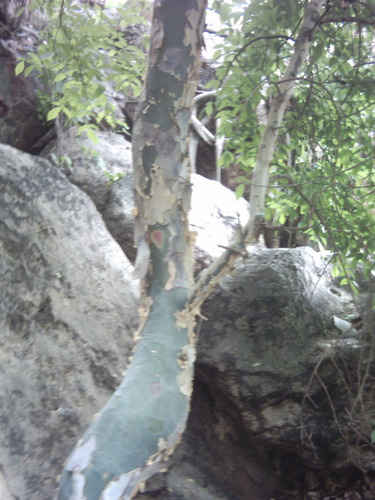
A deciduous tree. It has clean stems. It grows up to 13 m high. The bark is smooth and succulent and blue in colour. The leaves have 3 leaflets or there are 2 pairs of leaflets and one at the end. The leaflets are oblong and 8 cm long by 4.7 cm wide. The edges of the leaves are wavy or toothed. The flowers are small and greenish-yellow. They occur either singly or in small clusters. The fruit are almost round and 1.5 cm across. It has a thin layer of pulp.
Notes
There are about 165 Commiphora species.
Names & Synonyms
Wému
References (5)
- Exell, A.W. et al, (Ed), 1963, Flora Zambesiaca Vol 2 Part 1 Crown Agents, London. p 281
- Lim, T. K., 2015, Edible Medicinal and Non Medicinal Plants. Volume 9, Modified Stems, Roots, Bulbs. Springer p 26
- NEWMAN, 1970,
- Palgrave, K.C., 1996, Trees of Southern Africa. Struik Publishers. p 359
- Peters, C. R., O'Brien, E. M., and Drummond, R.B., 1992, Edible Wild plants of Sub-saharan Africa. Kew. p 72


