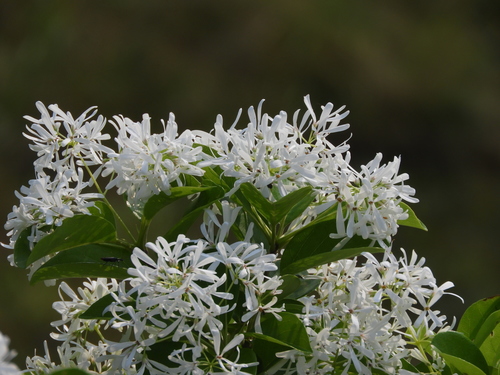
Fraxinus floribunda
Wall.
Himalayan manna ash

Wikimedia Commons - Krish Dulal

Wikimedia Commons - Krzysztof Ziarnek, Kenraiz
What to Eat
Edible parts: Sap
A manna is obtained by making incisions in the trunk. It is used as a sweetener but is laxative if consumed in quantity.
Where to Find It
It is a temperate plant.
Asia, Britain, Europe, India, Nepal, Northeastern India, Sikkim,
How to Identify
A deciduous tree reaching 40 m (131 ft 3 in) tall, hardy to UK zone 8. Wind-pollinated flowers bloom from June to July. Dioecious, requiring both male and female plants for seed production. Grows in light sandy, medium loamy, or heavy clay soils with mildly acid to basic pH. Requires full sun and prefers moist soil. Tolerates strong winds and atmospheric pollution but not maritime exposure.
How to Grow
Prefers a deep loamy soil, even if it is on the heavy side. Most members of this genus are gross feeders and require a rich soil. Plants succeed when growing in exposed positions and also in alkaline soils. Plants tolerate atmospheric pollution. Closely related to F. ornus. This species is not very hardy in Britain but can succeed outdoors in the milder areas. It has a very wide range in the wild and there are probably provenances that will do much better in Britain. Dioecious. Male and female plants must be grown if seed is required.
Propagation: Seed is best harvested green — fully developed but not yet dried on the tree — and sown immediately in a cold frame, where it usually germinates in spring. Stored seed requires cold stratification and should be sown as soon as possible in a cold frame. Prick seedlings into individual pots when large enough and grow on in a cold frame through their first winter. Plant out into permanent positions or a nursery bed in late spring or early summer the following year. Where sufficient seed is available, sow directly into an outdoor seedbed in autumn and grow on for 2 years before transplanting.
Medicinal Uses
The manna obtained from stem incisions is a safe and gentle laxative. The young shoots are abortifacient.
Other Uses
The wood is used for oars, ploughs, and poles.
Wikipedia
Source ↗Fraxinus floribunda is a species of ash native to South Asia, East Asia, and Southeast Asia. It is known from Afghanistan, Pakistan, Nepal, Assam, Bhutan, Laos, Myanmar (Burma), Thailand, Vietnam, the Ryukyu Islands, and parts of China (Guangdong, Guangxi, Guizhou, Xizang, Yunnan, Zhejiang). Fraxinus floribunda is a medium-sized deciduous tree growing to 10–15 m tall with a trunk up to 50 cm diameter, with grey bark. Leaves opposite, pinnate, with 7–9 serrate leaflets. Flowers white, with petals 3–4 mm long, in large branched clusters up to 25 cm across. Fruit a nut, with a long narrow wing 2.5–4 cm long by 3–4 mm wide.
Names & Synonyms
Lakurni, Lankoori, Rukh harchoor
References (2)
- Plants for a Future.
- Savita, et al, 2006, Studies on wild edible plants of ethnic people in east Sikkim. Asian J. of Bio Sci. (2006) Vol. 1 No. 2 : 117-125