Commiphora neglecta
Verdoorn
Sweet-root commiphora

(c) Tinus Oberholzer, some rights reserved (CC BY-NC), uploaded by Tinus Oberholzer

(c) Richard Gill, some rights reserved (CC BY-NC), uploaded by Richard Gill
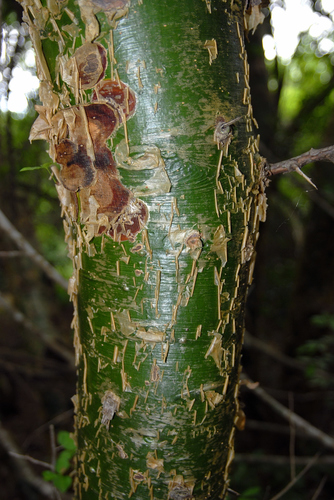
(c) Francois du Randt, some rights reserved (CC BY-NC), uploaded by Francois du Randt
What to Eat
Edible parts: Roots, Leaves
The roots are eaten like sugarcane after removing the skin—they have a sweet taste. The leaves are also edible.
Known Hazards
Where to Find It
A tropical plant. It grows on sandy flats and amongst rocks on hot slopes. It grows in areas with a rainfall between 500-700 mm per year. It can grow in arid places.
Africa, East Africa, Eswatini, Kenya, Mozambique, South Africa, Southern Africa, Swaziland, Zimbabwe,
How to Identify
A slender tree. It grows up to 5 m tall. The stem is thick and greenish. The bark peels in small thin papery flakes. The branches often droop. They are slightly hairy when young and have spines at the tip. The leaves are composed of three leaflets. The leaves have a smell of resin when crushed. The leaflets are egg shaped and vary in size. The end leaflet is the largest. The leaflets narrow towards the base. The leaves are shiny and can be bright green or grey-green. The midrib is yellow and raised underneath the leaf. Leaves can be 7.5 cm long and 5 cm wide. The leaflets do not have stalks but the leaves have long slender stalks. The flowers grow on short side shoot. They flowers are small. The fruit are round or oval and about 1.3 cm across. They are green but turn red as they ripen and split to show the seed inside. There is a fleshy layer around the seed which has 4 wing like arms.
How to Grow
It can be grown by seed or cuttings.
Other Information
A famine food. It is a significant occasional food in Mozambique.
Notes
There are about 165 Commiphora species.
Names & Synonyms
Liminyela, Mu-kerenju, Neglected commiphora, Sweet-root corkwood
References (16)
- Cunningham, 1985,
- Exell, A.W. et al, (Ed), 1963, Flora Zambesiaca Vol 2 Part 1 Crown Agents, London. p 271
- Fox, F. W. & Young, M. E. N., 1982, Food from the Veld. Delta Books. p 140
- Lim, T. K., 2015, Edible Medicinal and Non Medicinal Plants. Volume 9, Modified Stems, Roots, Bulbs. Springer p 27
- Long, C., 2005, Swaziland's Flora - siSwati names and Uses http://www.sntc.org.sz/flora/
- Palgrave, K.C., 1996, Trees of Southern Africa. Struik Publishers. p 368
- Palmer, E and Pitman, N., 1972, Trees of Southern Africa. Vol. 2. A.A. Balkema, Cape Town p 1027
- Peters, C. R., O'Brien, E. M., and Drummond, R.B., 1992, Edible Wild plants of Sub-saharan Africa. Kew. p 73
- RILEY & BROKENSHA,
- Royal Botanic Gardens, Kew (1999). Survey of Economic Plants for Arid and Semi-Arid Lands (SEPASAL) database. Published on the Internet; http://www.rbgkew.org.uk/ceb/sepasal/internet [Accessed 5th April 2011]
- Ruiters-Welcome, A. K., 2019, Food plants of southern Africa. Ph.D. thesis. Univ. of Johannesburg p 40
- Schmidt, E., Lotter, M., & McCleland, W., 2007, Trees and shrubs of Mpumalanga and Kruger National Park. Jacana Media p 246
- Swaziland's Flora Database http://www.sntc.org.sz/flora
- van Wyk, Be., & Gericke, N., 2007, People's plants. A Guide to Useful Plants of Southern Africa. Briza. p 84
- Welcome, A. K. & Van Wyk, B.-E., 2019, An inventory and analysis of the food plants of southern Africa. South African Journal of Botany 122 (2019) 136–179
- World Checklist of Useful Plant Species 2020. Royal Botanic Gardens, Kew


