Connarus semidecandrus
Jack
Decandrus connarus
(c) guanhong, some rights reserved (CC BY-NC), uploaded by guanhong

(c) Jarupa Panitchpakdi, some rights reserved (CC BY-NC)

(c) Jarupa Panitchpakdi, some rights reserved (CC BY-NC)
What to Eat
Edible parts: Leaves
The young leaves are eaten.
Where to Find It
A tropical plant. It occurs in secondary forests and on plains below 1000 m altitude in tropical Asia.
Asia, Cambodia, Indochina, Indonesia, Laos, Malaysia, SE Asia, Singapore, Thailand, Vietnam,
How to Identify
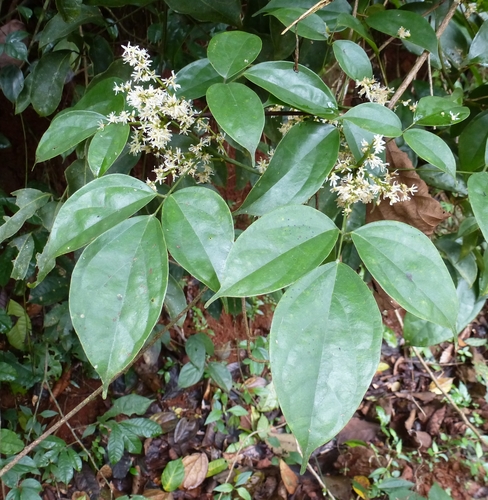
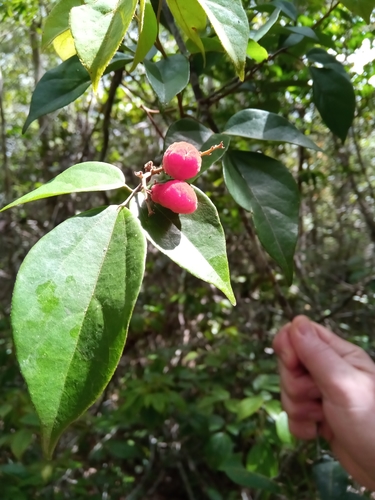
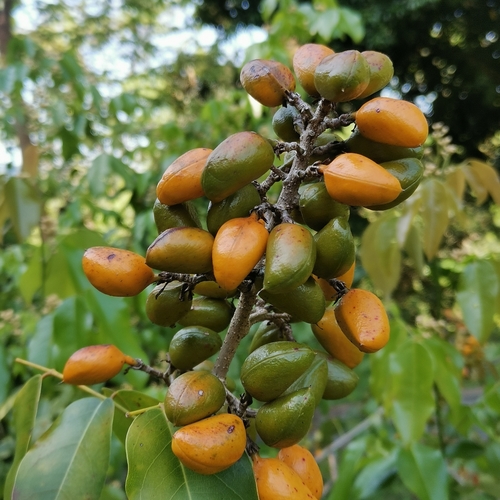
A shrub. It grows 1-2 m high. It can climb. The leaves are compound with leaflets along the stalk and one at the end. There are 3-7 leaflets. They are oval and 4-20 cm long by 2-7 cm wide. The flowers are on long stalks at the end of the plant. There are many flowers in a group. They are white but fade to brownish. The fruit is a follicle that turns orange when ripe. The seeds are black with an orange yellow aril of layer around them.
Medicinal Uses
It is used as a medicinal plant in Thailand.
Notes
There are about 100 Connarus species. It is a medicinal plant in Thailand.
Names & Synonyms
Akar kuayah, Akar tukar, Konarusa, Lopbop, Lumpu'ehs daek, Tenggek burung, Terung tenggek, Thopthaep khruea
References (6)
- Burkill, I.H., 1966, A Dictionary of the Economic Products of the Malay Peninsula. Ministry of Agriculture and Cooperatives, Kuala Lumpur, Malaysia. Vol 1 (A-H) p 659
- Kachenchart, B., et al, 2008, Phenology of Edible Plants at Sakaerat Forest. In Proceedings of the FORTROP II: Tropical Forestry Change in a Changing World. Bangkok, Thailand.
- Leenhouts, P.W., 1958, Connaraceae in Flora Malesiana 5(4) p 534
- Phon, P., 2000, Plants used in Cambodia. © Pauline Dy Phon, Phnom Penh, Cambodia. p 172
- Sukarya, D. G., (Ed.) 2013, 3,500 Plant Species of the Botanic Gardens of Indonesia. LIPI p 915
- Thoa P. T. K., et al, 2013, Biodiversity indices and utilization of edible wild plants: a case study of the Cham Island in Quang Nam Province, Vietnam. Journal of Research in Environmental Science and Toxicology 2(9) :167-174