Piper gibbilimbum
C. DC.
PiperaceaeLeaves

gbif · cc0
President and Fellows of Harvard College
President and Fellows of Harvard College

gbif · cc0
President and Fellows of Harvard College
President and Fellows of Harvard College

gbif · cc0
President and Fellows of Harvard College
President and Fellows of Harvard College
What to Eat
Edible parts: Leaves - masticatory
The leaves are used as a masticatory.
Where to Find It
It is a tropical plant. It grows in secondary forest and often near streams between 1,300-2,000 m above sea level.
Asia, Indonesia, Papua, Papua New Guinea, PNG, SE Asia,
Countries: United Arab Emirates, Afghanistan, Armenia, Azerbaijan, Bangladesh, Bahrain, Brunei, Bhutan, China, Georgia, Indonesia, Israel, India, Iraq, Iran, Jordan, Japan, Kyrgyzstan, Cambodia, North Korea, South Korea, Kuwait, Kazakhstan, Laos, Lebanon, Sri Lanka, Myanmar, Mongolia, Maldives, Malaysia, Nepal, Oman, Papua New Guinea, Philippines, Pakistan, Qatar, Saudi Arabia, Singapore, Syria, Thailand, Tajikistan, Timor-Leste, Turkmenistan, Turkey, Taiwan, Uzbekistan, Vietnam, Yemen
How to Identify
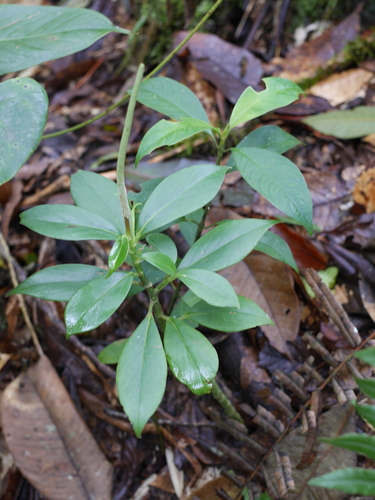
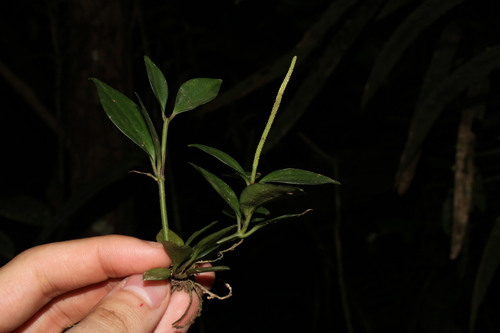
A shrub. It grows 2-4 m tall. The leaves are 17 cm long by 15 cm wide. They are broadly oval and heart shaped at the base. On fertile shoots the leaves are smaller. Male flowers are in a spike 10 cm long and 3-5 mm wide. The female flowers are in a spike 10 cm long and 0.6 mm wide. The small fruit are orange when ripe and hang down.
References (2)
- Gardner, R. O., 2003, Piper (Piperaceae) in New Guinea: The non-climbing species. BLUMEA 48:47-68
- World Checklist of Useful Plant Species 2020. Royal Botanic Gardens, Kew