Iris caucasica
Hoffm.
IridaceaeFlowers
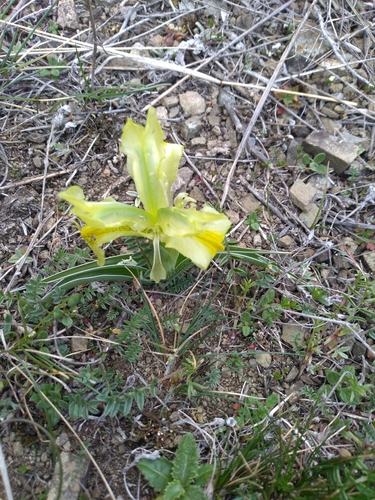
iNaturalist · cc-by-nc
(c) Tamar, some rights reserved (CC BY-NC), uploaded by Tamar
(c) Tamar, some rights reserved (CC BY-NC), uploaded by Tamar
What to Eat
Edible parts: Flowers
The flowers (tepals) are eaten fresh.
Where to Find It
It is a temperate plant.
Europe, Slovenia, Turkey, Türkiye,
Countries: Andorra, Albania, Austria, Bosnia & Herzegovina, Belgium, Bulgaria, Belarus, Switzerland, Cyprus, Czechia, Germany, Denmark, Estonia, Spain, Finland, France, United Kingdom, Greece, Croatia, Hungary, Ireland, Iceland, Italy, Liechtenstein, Lithuania, Luxembourg, Latvia, Monaco, Moldova, Montenegro, North Macedonia, Malta, Netherlands, Norway, Poland, Portugal, Romania, Serbia, Russia, Sweden, Slovenia, Slovakia, San Marino, Turkey, Ukraine
How to Identify
A temperate bulb plant in the Iris family.
Wikipedia
Source ↗Iris caucasica (also known as Caucasian iris) is a species of plant in the genus Iris, it is also in the subgenus of Scorpiris. Pronounced as 'kaw-KAS-ee-kuh'. It is a bulbous perennial. It was described in 1808 by Georg Hoffman in Commentat. Soc. Phys.-Med. Univ. Litt. Caes. Mosq. It was once confused with Iris orchioides, but Iris caucasica is a smaller plant, with sessile flowers. Also it has leaves that have white margins. Iris caucasica is an accepted name by the Royal Horticultural Society.
Names & Synonyms
Gizmemesi, Kaf navruzu, Kavkaška perunika, Keku, Kuelbiza, Tumane
Coresantha caucasica (Hoffm.) KlattCostia caucasica (Hoffm.) Willk.Iris caucasica subsp. caucasicaJuno caucasica (Hoffm.) Tratt.Neubeckia caucasica (Hoffm.) Alef.Thelysia caucasica (Hoffm.) Parl.Xiphion caucasicum (Hoffm.) Baker
References (3)
- Cakir, E. A., 2017, Traditional knowledge of wild edible plants of Iğdır Province (East Anatolia, Turkey). Acta Soc Bot Pol. 2017;86(4):3568.
- Ertug, F, Yenen Bitkiler. Resimli Türkiye Florası -I- Flora of Turkey - Ethnobotany supplement
- Polat, R., et al, 2017, Survey of wild food plants for human consumption in Bingol, (Turkey). Indian Journal of Traditional Knowledge. Vol. 16(3) July 2017, pp. 378-384


