Geranium robertianum
L.
Herb Robert

(c) Borja Fierro, some rights reserved (CC BY), uploaded by Borja Fierro

(c) Roberto Daniel Avila, some rights reserved (CC BY), uploaded by Roberto Daniel Avila

(c) Gilles San Martin, some rights reserved (CC BY-SA), uploaded by Gilles San Martin
What to Eat
Edible parts: Leaves, Flowers, Roots
None known
Where to Find It
It is a temperate plant. It is usually in shady positions.
Central Asia, Falklands, Georgia, Luxembourg, North America, Norway, Scandinavia, Slovenia, Tajikistan, USA,
How to Identify
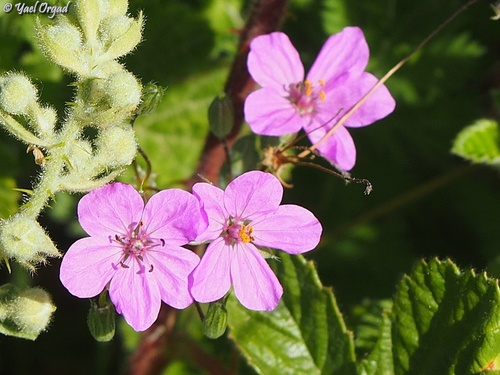
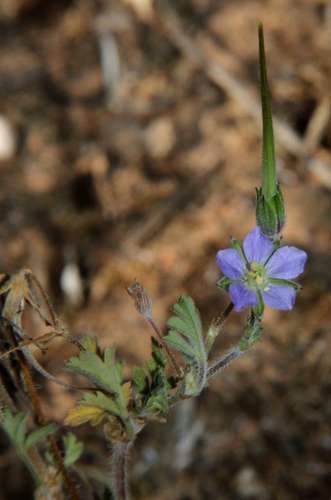
A herb. It is a sprawling plant. It has an unpleasant smell. It grows 30-40 cm tall. The leaves are dark green and divided like fingers on a hand. They are 6 cm long and have leaflets that are light green with purple edges. The flowers are star shaped and up to 2 cm across. They are dark red. They are usually in pairs near the end of the plant.
How to Grow
Succeeds in any moderately fertile retentive soil in a sunny position. Tolerates a wide range of soil types, succeeding in dry soils. Grows well on woodland edges. The whole plant has an unpleasant aroma. The foxy smell is particularly pronounced after rain. Members of this genus are rarely if ever troubled by browsing deer or rabbits.
Propagation: Sow seed in spring directly in situ.
Medicinal Uses
Herb Robert sees little use in modern herbalism but is occasionally employed as an astringent to halt bleeding and treat diarrhoea, in much the same way as G. maculatum. The leaves are antirheumatic, mildly diuretic, and vulnerary. Modern research has shown they can lower blood sugar levels, making the plant potentially useful in treating diabetes. An infusion of the leaves is used for bleeding, stomach ailments, kidney infections, and jaundice. Externally, a wash or poultice is applied to swollen or painful breasts, rheumatic joints, bruises, and bleeding. It is best to use the entire plant including the roots. The plant can be harvested any time from late spring to early autumn and is generally used fresh. A homeopathic remedy is also made from the plant, though specific details of those uses are not provided here.
Other Uses
Freshly picked leaves rubbed on the skin help repel mosquitoes, imparting their distinctive odour. A brown dye can be obtained from the whole plant.
Wikipedia
Source ↗Geranium robertianum, commonly known as herb-robert or, in North America, as Robert's geranium, is a species of cranesbill that is widespread throughout the northern hemisphere and introduced to some countries in the southern. It is common in woods, hedges, gardens, and on waste ground, and can also be found on shingle beaches and limestone pavements. It is not rare or threatened and in some places it is considered to be invasive.
Names & Synonyms
Blood wort, Nemsits'vera, Smrdljička, Stankstorkenebb
References (4)
- Bussman, R. W., et al, 2021, Unity in diversity—food plants and fungi of Sakartvelo (Republic of Georgia), Caucasus. Journal of Ethnobiology and Ethnomedicine (2021) 17:72 p 9
- Girard, N. J., 2020, Sustainable Foraging of Wild Edible Plants in Norway. A Biocultural Approach. M. Sc. thesis Norwegian University. p 131
- Upson, R., & Lewis R., 2014, Updated Vascular Plant Checklist and Atlas for the Falkland Islands. Falklands Conservation and Kew.
- www.ediblewildfood.com