Coprosma areolata
Cheesem.
Thin-leaved coprosma
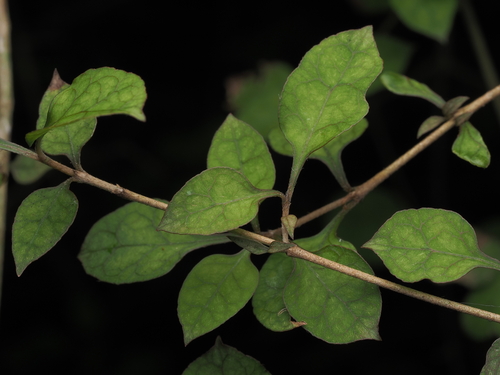
(c) Saryu Mae 前 朝琉, some rights reserved (CC BY), uploaded by Saryu Mae 前 朝琉

(c) xfionasmalx, some rights reserved (CC BY-NC)

(c) scottishrob, some rights reserved (CC BY-NC)
What to Eat
Edible parts: Fruit, Seeds - coffee
The fruit is eaten raw and is sweet, though with little flavour. The dark purple fruit is up to 5mm wide. The roasted seed makes an excellent coffee substitute.
Where to Find It
It is a temperate plant. In New Zealand it grows from sea level to 960 m altitude.
New Zealand,
How to Identify
A shrub or small tree. It grows up to 5 m tall. The flowers can occur singly or in groups or 2 to 4. They are at the end of the small branches.
How to Grow
Requires a moist, very well-drained neutral to slightly acid soil in full sun or light shade. Succeeds in most soils. Somewhat intolerant of frost, this species is only likely to succeed outdoors when grown in a woodland garden in the milder areas of Britain. Hybridizes freely with other members of this genus. Plants grown in Britain to date (1994) have not flowered. Plants are tolerant of heavy clipping or pruning. Plants are normally dioecious, though in some species the plants produce a few flowers of the opposite sex before the main flowering and a few hermaphrodite flowers are sometimes produced. Male and female plants must usually be grown if seed is required.
Propagation: Seed is best sown as soon as it is ripe in a greenhouse or cold frame. Stored seed can be sown in spring in a cold frame. Germination is often slow, taking more than 12 months even with fresh seed. Prick seedlings out into individual pots once large enough to handle, and grow on under glass for at least their first winter before planting out in late spring or early summer. Provide some cold protection during the first winter outdoors. Cuttings of mature wood from the current year's growth can be taken in autumn and rooted in a frame.
Medicinal Uses
None known.
Other Uses
A yellow dye obtained from the wood does not require a mordant.
Wikipedia
Source ↗Coprosma areolata, commonly known as thin-leaved coprosma, is a species of shrub that is native to New Zealand. C. areolata grows in wet, lowland forest and can also grow in exposed places. Coprosma is from the Greek kopros 'dung' and osme 'smell', referring to the foul smell of the species, literally 'dung smell'. And areolata is netted, with a network pattern between the veins.
Notes
There are about 90 Coprosma species.
References (2)
- Plants for a Future database, The Field, Penpol, Lostwithiel, Cornwall, PL22 0NG, UK. http://www.scs.leeds.ac.uk/pfaf/
- Salmon, J.T., 1989, The Native Trees of New Zealand. Heinmann Reid p 301


