Coprosma nitida
Hook. f.
Mountain currant, Shining Coprosma, Mountain Currant Bush
(c) jk0000, some rights reserved (CC BY-NC)
(c) jk0000, some rights reserved (CC BY-NC)

(c) euky, some rights reserved (CC BY-NC)
What to Eat
Edible parts: Fruit
The orange-red fruit, about 6mm in diameter, can be eaten raw. Opinion on the flavour varies — one source describes it as sweetish but unpleasant, while another rates it positively. The roasted seed makes an excellent coffee substitute.
Where to Find It
It grows in alpine regions often on drier dolerite mountains among rocks. It grows above 900 m altitude in cool temperate locations. It can tolerate snow and frost. Tasmania Herbarium.
Australia*, Tasmania*,
How to Identify
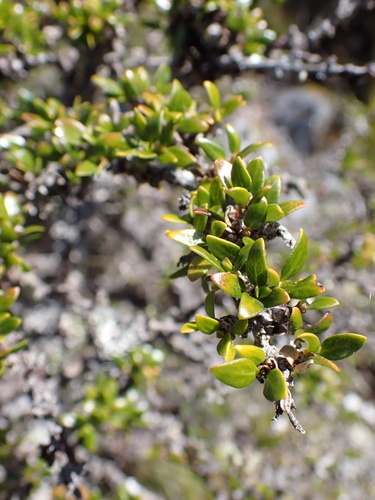
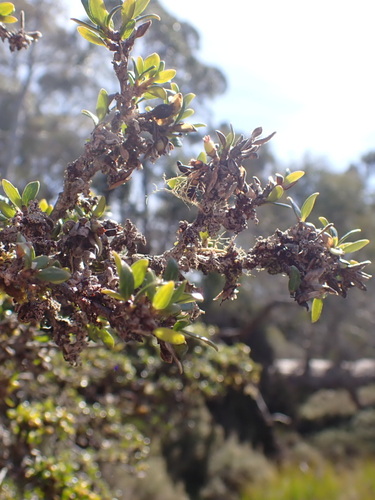
A prickly shrub. It is often less than 1 m tall but can be 3 m tall. The leaves are shiny. They are 10 mm long and 5 mm wide. The leaves occur opposite each other along the stem. Male and female flowers occur on different plants. The petals are small and the stamens or styles are large. The fruit are orange-red and shiny. They are edible.
How to Grow
Plants can be grown from seed. Seed can be collected from the fleshy fruit. They can also be grown from stem cuttings. If the seeds have been dried and stored they need pre-treatment before sowing. They can be soaked in vinegar or other acid for 24 hours or longer. They should be then drained and rinsed before sowing. They can be sown in a nursery in potting mix and transplanted out to small pots then the garden situation.
Propagation: Seed is probably best sown as soon as it is ripe in a greenhouse or cold frame. Stored seed should be sown in spring in a cold frame. Germination can be slow, often taking more than 12 months even with fresh seed. Prick seedlings out into individual pots once large enough to handle. Grow plants through at least their first winter under glass before planting out in late spring or early summer, and give some cold protection during their first winter outdoors. Cuttings of mature wood from the current year's growth can be taken in autumn and rooted in a frame.
Medicinal Uses
None known.
Other Uses
A yellow dye is obtained from the wood and requires no mordant.
Wikipedia
Source ↗Coprosma nitida, the mountain currant or shining currant, is a shrub species endemic to south-east Australia. It is a shrub with small, glossy leaves, occasional spines on the end of its branchlets, and small bright red-orange fruits.
Notes
There are about 90 Coprosma species.
References (11)
- Cameron, M., (Ed.) 1981, A Guide to Flowers & Plants of Tasmania. Reed p 48
- Collier, P., 1995, Alpine Wildflowers of Tasmania. Plant Identikit. Society for growing Australian Plants. Tasmania. p 63
- Cribb, A.B. & J.W., 1976, Wild Food in Australia, Fontana. p 27
- Cronin, L., 1989, The Concise Australian Flora. Reed. p 42
- Curtis, W.M., 1963, The Students Flora of Tasmania Vol 2 p 269
- Elliot, W.R., & Jones, D.L., 1984, Encyclopedia of Australian Plants suitable for cultivation. Vol 3. Lothian. p 85
- Kirkpatrick, J., 1997, Alpine Tasmania, An Illustrated guide to the flora and vegetation. Oxford, p 49
- London J. Bot. 6:465. 1847
- Plants for a Future database, The Field, Penpol, Lostwithiel, Cornwall, PL22 0NG, UK. http://www.scs.leeds.ac.uk/pfaf/
- Tasmanian Herbarium Vascular Plants list p 51
- Whiting, J. et al, 2004, Tasmania's Natural Flora. Tasmania's Natural Flora Editorial Committee PO Box 194, Ulverstone, Tasmania, Australia 7315 p 295


