Tabebuia aurea
(Silva Manso) Benth. & Hook.f. ex S. Moore
Golden trumpet tree

(c) Tatters ✾, some rights reserved (CC BY-SA)
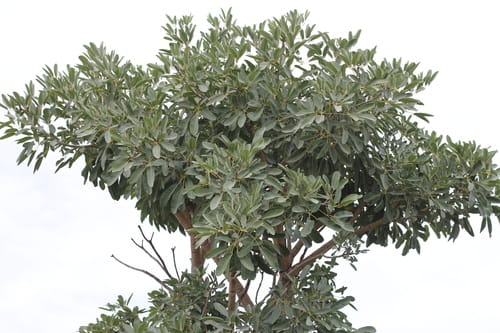
(c) Romi Galeota Lencina, some rights reserved (CC BY)

(c) kbatistaa, some rights reserved (CC BY-NC)
What to Eat
Edible parts: Flowers
The flowers are edible.
Where to Find It
It is a tropical plant.
Amazon, Argentina, Bolivia, Brazil, Colombia, Paraguay, Peru, South America, Suriname, Venezuela,
How to Identify
A small tree. It grows 10-16 m tall. The branches are covered with scales. The leaves are compound and have leaflets like fingers on a hand. There are 5-7 leaflets. They are 6-14 cm long by 2-3 cm wide. The flowers are in a bell shaped structure and these have 5 irregular lobes. The flowers are yellow and 5-6 cm long and funnel shaped. The fruit are 10-12 cm long by 1-1.2 cm wide. The seeds are oblong and 2 cm long.
How to Grow
This tree is found in a wide variety of habitats - forms from the north of its range succeed in marshy or seasonally inundated soils whilst forms from the south grow in well-drained, seasonally very dry soils. Growing wild in harsh conditions, it may develop 'rubbery' growth and become unstable in overly fertile soil. Freshly planted young trees are slow to establish and grow away.
Propagation: Seed - remains viable for at least 4 months. It is best sown as soon as it is ripe in individual containers. The germination rate is usually over 50%, with seeds sprouting in 10 - 20 days.
Other Uses
The wood is hard, moderately heavy, of low resistance to rot. It is moderately textured, of irregular grain and extremely flexible. It is used for tool handles, objects that need to be curved, flexible rulers, furniture, frames, construction etc.
Wikipedia
Source ↗Tabebuia aurea is a species of Tabebuia native to South America in Suriname, Brazil, eastern Bolivia, Peru, Paraguay, and northern Argentina. The common English name Caribbean trumpet tree is misleading, as it is not native to the Caribbean. It is also known as the silver trumpet tree, and tree of gold.
Names & Synonyms
Alcornoque, Alchornoque, Caraiba, Caraibeira, Carauba, Caroba-do-campo, Caribbean trumpet-tree, Cinco-folhas-do-campo, Cinco-em-rama, Craibeira, Ipe, Ipe-amarelo, Lapacho amarillo, Paraguayan trumpet-tree, Paratodo, Paratudo, Pau-d'arco, Tajibillo, Tajibo morado
References (2)
- Bortolotto, I. M., et al, 2018, Lista preliminar das plantas alimenticias nativas de Mato Grosso do Sul, Brasil. Iheringia, Serie Botanica, Porto Alegre, 73 (supl.):101-116
- Grandtner, M. M. & Chevrette, J., 2013, Dictionary of Trees, Volume 2: South America: Nomenclature, Taxonomy and Ecology. Academic Press p 647


