Coprosma pumila
Hook.f.
Creeping Coprosma, Small mat coprosma
(c) Phil Collier, some rights reserved (CC BY-NC)
(c) Phil Collier, some rights reserved (CC BY-NC)
(c) Phil Collier, some rights reserved (CC BY-NC)
What to Eat
Edible parts: Fruit, Seeds - coffee
The orange-red fleshy fruit can be eaten raw or cooked. It is sweet but has little flavour. Fruit is typically about 7mm in diameter, though forms bearing fruit up to 13mm across have been recorded. The roasted seed makes an excellent coffee substitute.
Where to Find It
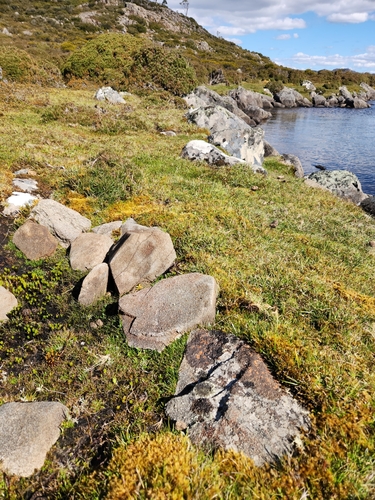
It is a temperate plant. It grows in subalpine places above 500 m altitude. It requires cool, moist conditions. It needs rich, well drained soil. Tasmania Herbarium.
Australia*, New Zealand, Tasmania*,
How to Identify
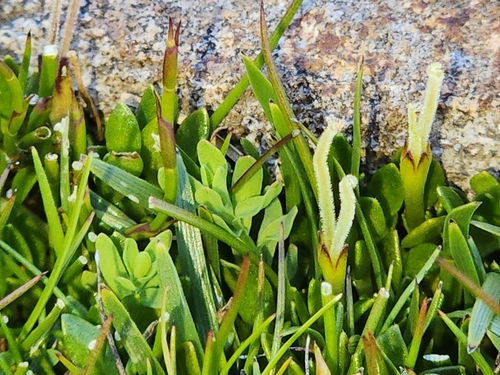
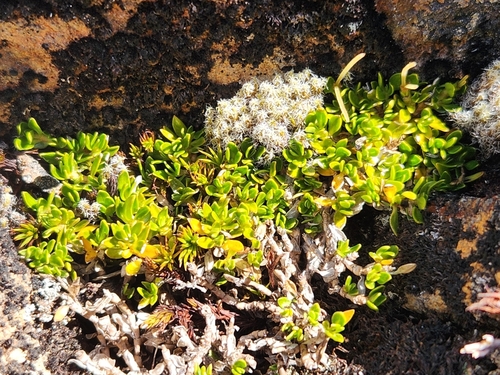
A small matted shrub which grows along the ground. It spreads 30-100 cm wide. It roots at the nodes. The leaves are 0.5-1 cm long and 0.2-0.3 cm wide. They are shiny. Male and female flowers are on separate plants. The flowers are about 0.8 cm long. They occur singly at the ends of short branches. They are green. The fruit is fleshy with a hard stone inside and is 0.6-0.8 cm wide. It is orange or red.
How to Grow
Requires a moist, very well-drained neutral to slightly acid soil in full sun or light shade. Prefers a permanent moist and peaty soil, but it is not an easy plant to grow in Britain. Somewhat intolerant of frost, this species is only likely to succeed outdoors in the milder areas of Britain. Another report says that it is fully hardy in Britain. Closely related to C. atropurpurea and often confused with that species. It is a very variable plant, hybridizing freely with other members of this genus. Plants are normally dioecious, though in some species the plants produce a few flowers of the opposite sex before the main flowering and a few hermaphrodite flowers are sometimes produced. Male and female plants must usually be grown if seed is required. There is some confusion over the correct name of this species, it could be a part of C. petriei.
Propagation: Seed is probably best sown as soon as it is ripe in a greenhouse or cold frame. Stored seed should be sown in spring in a cold frame. Germination can be slow, often taking more than 12 months even with fresh seed. Prick seedlings out into individual pots once large enough to handle. Grow plants through at least their first winter under glass before planting out in late spring or early summer, and give some cold protection during their first winter outdoors. Cuttings of mature wood from the current year's growth can be taken in autumn and rooted in a frame.
Medicinal Uses
None known.
Other Uses
A yellow dye is obtained from the wood and requires no mordant.
Wikipedia
Source ↗Coprosma pumila is an evergreen shrub found in Australia and New Zealand.
Notes
There are about 90 Coprosma species.
Names & Synonyms
References (8)
- Elliot, W.R., & Jones, D.L., 1984, Encyclopedia of Australian Plants suitable for cultivation. Vol 3. Lothian. p 85
- Hibbert, M., 2002, The Aussie Plant Finder 2002, Florilegium. p 72
- Kirkpatrick, J., 1997, Alpine Tasmania, An Illustrated guide to the flora and vegetation. Oxford, p
- Lavelle, M., 2008, Wild Flowers of Australia and Oceania. Southwater. p 83
- Morley, B. & Everard, B., 1970, Wild Flowers of the World. Ebury press. Plate 2
- Plants for a Future database, The Field, Penpol, Lostwithiel, Cornwall, PL22 0NG, UK. http://www.scs.leeds.ac.uk/pfaf/
- Tasmanian Herbarium Vascular Plants list p 51
- Whiting, J. et al, 2004, Tasmania's Natural Flora. Tasmania's Natural Flora Editorial Committee PO Box 194, Ulverstone, Tasmania, Australia 7315 p 295


