Coptis trifolia
(L.) Salisb.
Goldthread, Cankerroot, Coptis, Yellowroot
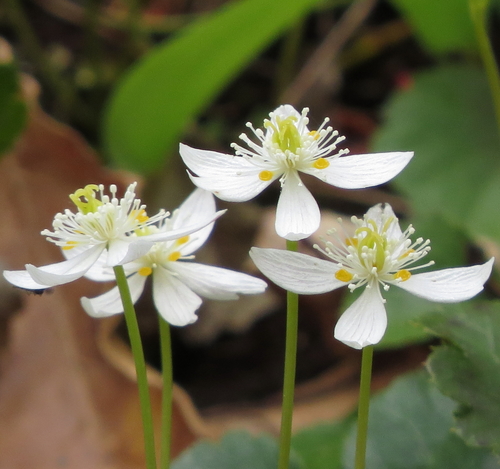
(c) cgbb2004, some rights reserved (CC BY-NC)

(c) Superior National Forest, some rights reserved (CC BY)
What to Eat
Edible parts: Leaves
The whole plant is said to be edible. It can also be combined with sassafras-root bark and Irish moss and brewed into a herbal root beer, to which it contributes a bitter flavour and a yellow colour. Some caution is advised due to the plant's toxicity.
Where to Find It
It is a temperate plant. It suits cool, moist situations. It can grow in swamps. It is resistant to frost but damaged by drought.
Alaska, Arctic, Asia, Australia, Canada, Europe, Greenland, Iceland, Japan, North America*, USA,
How to Identify
A small evergreen plant. It grows 8-15 cm high. It forms low mats. The roots are slender and a golden colour. The leaves are shiny and have 3 leaflets. The flowers occur singly and are saucer shaped. They are white.
How to Grow
Plants can be grown by division.
Propagation: Seed is best sown in a greenhouse as soon as it is ripe, using an ericaceous compost. Seal the pot in a polythene bag until germination occurs, typically within 1–6 months at 10°c. Stored seed should be sown as early in the year as possible; four weeks of cold stratification may improve germination. Prick seedlings into individual pots when large enough to handle and grow on in a shady part of the greenhouse for at least their first winter. Plant out in mid-autumn or spring. The plant can also be divided in spring.
Medicinal Uses
Goldenthread is a very bitter herb formerly highly valued and widely used in North America by native Indians and settlers alike, though it is little used in modern herbalism. It was employed mainly to treat soreness in the mouth. The dried roots, stems and leaves are antiphlogistic, highly astringent, sedative, stomachic and tonic. The plant is valued as a local application for thrush in children and is also used for ulcerated mouths and as a gargle for sore throats. It is said to be useful for dyspepsia and helpful in combating the drink habit. The plant contains the alkaloid berberine, which is a mild sedative, anti-inflammatory and antibacterial. The root is collected in autumn and dried for later use.
Other Uses
A yellow dye is obtained from the leaves and stems. The plant can also be grown as ground cover in the peat garden.
Wikipedia
Source ↗Coptis trifolia, commonly known as the threeleaf goldthread or savoyane, is a perennial plant in the family Ranunculaceae native to North America.
Notes
There are about 8 Coptis species. The yellow die from the roots is used as a tonic.
Names & Synonyms
References (6)
- Facciola, S., 1998, Cornucopia 2: a Source Book of Edible Plants. Kampong Publications, p 190
- MacKinnon, A., et al, 2009, Edible & Medicinal Plants of Canada. Lone Pine. p 252
- Plants for a Future database, The Field, Penpol, Lostwithiel, Cornwall, PL22 0NG, UK. http://www.scs.leeds.ac.uk/pfaf/
- Slocum, P.D. & Robinson, P., 1999, Water Gardening. Water Lilies and Lotuses. Timber Press. p 113
- Tanaka,
- Trans. Linn. Soc. London 8:305. 1807


