Moronobea coccinea
Aubl.
Scarlet coccinea

(c) Guillaume Léotard, some rights reserved (CC BY-NC), uploaded by Guillaume Léotard
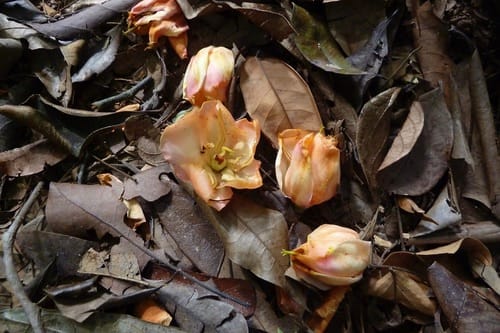
(c) coqwallon, some rights reserved (CC BY-NC)

(c) Nils Servientis - Bivouac Naturaliste, some rights reserved (CC BY-NC)
Where to Find It
It is a tropical plant.
Amazon, Bolivia, Brazil, Colombia, Ecuador, Guianas, Peru, South America, Venezuela,
How to Identify
A tree.
Medicinal Uses
The inner bark is scraped, boiled, and the water used as a herbal bath or as an antiseptic for various skin conditions. The inner bark is scraped and rubbed on the skin as a treatment for chicken pox.
Other Uses
An abundant yellow resin is obtained from the bark. It is used for fastening points and feathers to arrows, for waxing threads, for calking canoes, and for attaching stone chips or thorns on cassava graters, blades to knives, and axes to their handles. The resin is used for making huge torches for the lighting of large communal houses during tribal dances. Compact lumps of the dried, blackened material are heated and applied to the tops of small posts driven into the earthen floor. When ignited, it gives off a surprisingly bright light. The heartwood is light yellow, slightly veined; it is clearly demarcated from the 3 - 5cm wide band of sapwood. The texture is medium; the grain straight, but sometimes wavy in the periphery of logs. The wood is moderately durable, being very resistant to fungi and dry wood borers, moderately resistant to termites. The wood seasons slowly with a high risk of checking and distortion; once dry it is moderately stable in service. The wood works well with ordinary tools; nailing and screwing are good, but require pre-boring; gluing is correct. The wood is used for purposes such as heavy carpentry, industrial flooring, exterior jionery and panelling, bridges, railway sleepers, furniture components and sliced veneer.
Names & Synonyms
Anani-da-terra-firme, Azufre caspi, Bacuri, Bacuri-de-anta, Charicuelo, Coronobo, Koukouniefou, Kumapeke, Lagartillo, Mani, Maniballi, Manil peou, Marupa, Moronobo, Palo breo, Peraman
References (1)
- Grandtner, M. M. & Chevrette, J., 2013, Dictionary of Trees, Volume 2: South America: Nomenclature, Taxonomy and Ecology. Academic Press p 421


