Cayratia pedata
(Lam.) Gagnep.
Birdfoot grape vine

(c) risonkj, some rights reserved (CC BY-NC), uploaded by risonkj
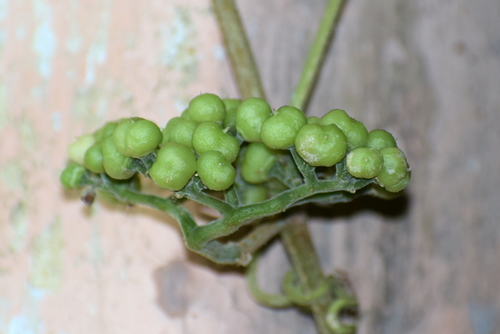
(c) Aniruddha Singhamahapatra, some rights reserved (CC BY-NC), uploaded by Aniruddha Singhamahapatra

(c) 🪶🐾🍀Nandan Sreejith🦌🍄🌍, some rights reserved (CC BY-NC), uploaded by 🪶🐾🍀Nandan Sreejith🦌🍄🌍
What to Eat
Edible parts: Leaves, Medicine
Leaf is used in the treatment of ulcers, inflammation, and scabies. The extract of the plant contains significant amounts of alkaloids, tannins, phenolic compounds, flavonoids, and terpenoids.
Where to Find It
It is a subtropical plant. It occurs in the Western Ghats in India. It grows between 800-2,200 m above sea level in China.
Asia, Bangladesh, China, India, Indonesia, Malaysia, Myanmar, Northeastern India, SE Asia, Sri Lanka, Thailand, Vietnam,
How to Identify
A vine. It has tendrils that enable it to attach to other plants. The leaves are simple and alternate. The leaf stalks are 7-13 cm long. The leaves are 7-15 cm long by 4-7 cm wide and have 5 leaflets or lobes.
Medicinal Uses
The leaves are used as astringents and refringents. The leaves have anti-arthritis activity. The whole plant (excluding the roots) has a low diuretic activity and has been used as a remedy for coughs, bronchitis, asthma, joint pain and to check uterine reflexes. The phytoconstituents present in this plant possess diuretic activities. The plant extract contains alkaloids, carbohydrates, steroids, tannin, phenolic compounds, flavonoids and terpenoids.
Wikipedia
Source ↗Cayratia pedata, popularly known as birdfoot grapevine, is a species of flowering plant in the family Vitaceae.
Names & Synonyms
Nimso repak
References (1)
- Teron, R. & Borthakur, S. K., 2016, Edible Medicines: An Exploration of Medicinal Plants in Dietary Practices of Karbi Tribal Population of Assam, Northeast India. In Mondal, N. & Sen, J.(Ed.) Nutrition and Health among tribal populations of India. p 156


