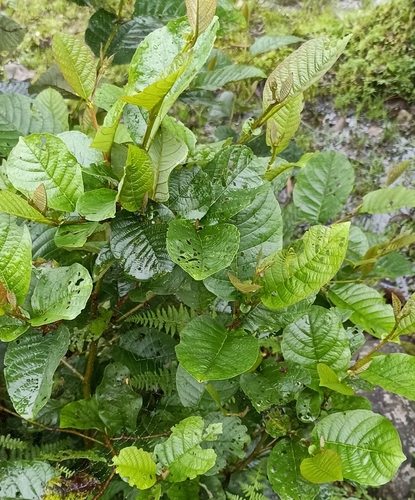
Corylus cornuta
Marshall
Beaked hazelnut, Beaked filbert

(c) Bryan Pfeiffer, some rights reserved (CC BY-NC)
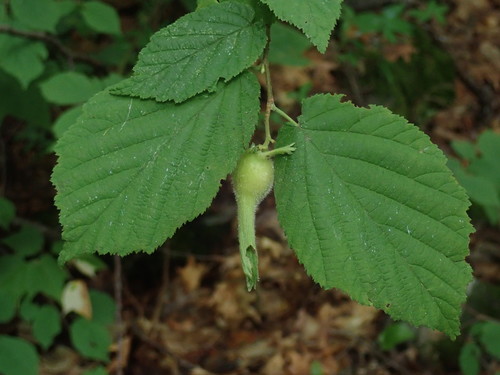
no rights reserved, uploaded by Lynn Harper
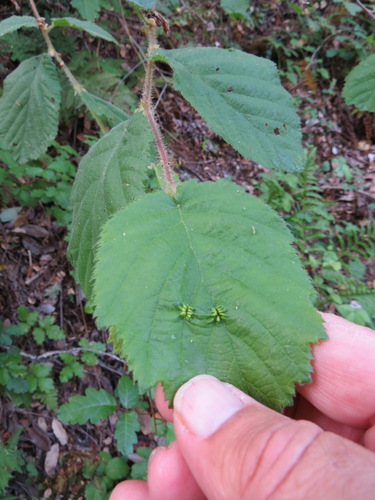
(c) Garth Harwood, some rights reserved (CC BY)
What to Eat
Edible parts: Nuts, Seeds
The seed can be eaten raw or cooked and is very popular in America, being sweet and well-flavoured with a thin shell. It can also be dried and ground into a powder to add to cereals or use in making bread and pies. The seed ripens in mid to late autumn and will likely need protection from squirrels. Stored unshelled in a cool place, nuts keep for at least 12 months. An edible oil is obtained from the seed.
Where to Find It
It likes moist well drained soil. It grows in shady forest near the coast and in more open rocky areas further inland. It suits hardiness zones 4-8.
Australia, Canada, North America*, USA,
How to Identify
A spreading deciduous shrub. It is erect and 3 m high. The leaves are oval and have lobes. There are teeth along the edges. The flowers are in catkins about 30 mm long. The nut is encased in a long brown or green sheath. They are produced in clusters of 1-4. The nuts are about 12 mm long.
Nutrition Score: 56/100
| Part | Moisture | kJ | kcal | Protein | Vit A | Vit C | Iron | Zinc |
|---|---|---|---|---|---|---|---|---|
| Nuts | 5.9 | 2629 | 628 | 14.9 | — | — | — | — |
How to Grow
An easily grown plant, it succeeds in most soils, but is in general more productive of seeds when grown on soils of moderate fertility. It does less well in rich heavy soils or poor ones. Does well in a loamy soil. Very suitable for an alkaline soil, but it dislikes very acid soils. Tolerates a pH in the range 5.8 to 7.5. Plants are fairly wind tolerant. Plants are hardy to about -30°c. They thrive in a short growing season. This species is occasionally cultivated for its edible seed in N. America but is of no value in Britain as a seed bearer. Plants can bear fruit in 5 - 6 years from seed. Members of this genus bear transplanting well and can be easily moved even when relatively large. A clumping plant, forming a colony from shoots away from the crown but with a limited spread. Hazelnuts are typically harvested in late summer to early autumn when the nuts have matured and fallen from the trees. Hazels flower in late winter to early spring, with male catkins producing pollen before the female flowers emerge. Corylus species are considered medium to fast-growing, reaching a height of about 3 to 6 meters (10 to 20 feet) within 5 to 10 years, depending on the specific variety and growing conditions.
Propagation: Seed is best sown as soon as it is harvested in autumn in a cold frame, germinating in late winter or spring. Stored seed should be pre-soaked in warm water for 48 hours, then given 2 weeks of warm stratification followed by 3–4 months of cold stratification; it germinates in 1–6 months at 20°C. When large enough to handle, prick seedlings out into individual pots and grow on in a cold frame or sheltered spot outdoors through their first winter, then plant out in late spring or early summer. Layering in autumn is easy and takes about 6 months. Division of suckers in early spring is very easy; divisions can be planted straight into permanent positions.
Medicinal Uses
An infusion of the branches and leaves has been used to treat heart complaints and intestinal disorders. A decoction of the bark has been given to children to alleviate teething pain.
Other Uses
Hazels work well in agroforestry systems as hedging, windbreaks, or for erosion control, and can be intercropped with other plants to benefit soil health and biodiversity. Young sucker shoots, first soaked in urine to improve pliability, can be used to make rope. A blue dye is obtained from the root or inner bark. The branches are used in basketry. An oil is obtained from the seed. Hazels produce wind-pollinated catkins that are not rich in nectar but do provide pollen that some insects utilise. The nuts are a valuable food source for birds, small mammals, and insects, and dense foliage provides shelter and nesting habitat, with leaf litter supporting a variety of organisms. Rough bark and dense foliage also offer overwintering sites for invertebrates.
Wikipedia
Source ↗Corylus cornuta, the beaked hazelnut (or just beaked hazel), is a deciduous shrubby hazel with two subspecies found throughout most of North America.
Notes
There are about 15 Corylus species.
Names & Synonyms
References (24)
- Arbust. amer. 37. 1785
- Beckstrom-Sternberg, Stephen M., and James A. Duke. "The Foodplant Database." http://probe.nalusda.gov:8300/cgi-bin/browse/foodplantdb.(ACEDB version 4.0 - data version July 1994) (As Corylus rostrata)
- Bocek, B. R., 1984, Ethnobotany of Costanoan Indians, California, Based on Collections by John P. Harrington. Economic Botany 38(2): 240-255
- Brouk, B., 1975, Plants Consumed by Man. Academic Press, London. p 217 (As Corylus rostrata)
- Cundall, P., (ed.), 2004, Gardening Australia: flora: the gardener's bible. ABC Books. p 422
- Elias, T.S. & Dykeman P.A., 1990, Edible Wild Plants. A North American Field guide. Sterling, New York p 173
- Esperanca, M. J., 1988. Surviving in the wild. A glance at the wild plants and their uses. Vol. 1. p 86
- Etherington, K., & Imwold, D., (Eds), 2001, Botanica's Trees & Shrubs. The illustrated A-Z of over 8500 trees and shrubs. Random House, Australia. p 232
- Facciola, S., 1998, Cornucopia 2: a Source Book of Edible Plants. Kampong Publications, p 82
- Farrar, J.L., 1995, Trees of the Northern United States and Canada. Iowa State University press/Ames p 310
- Hedrick, U.P., 1919, (Ed.), Sturtevant's edible plants of the world. p 221 (As Corylus rostrata)
- Krochmal, A. & Krochmal, C., 1982, Uncultivated Nuts of The United States. United States Department of Agriculture Forest Service. p 8
- Kuhnlein, H. V. & Turner, N. J., 1991, Traditional Plant Foods of Canadian Indigebous Peoples. Nutrition, Botany and Use. Gordon and Breach Publishers.
- MacKinnon, A., et al, 2009, Edible & Medicinal Plants of Canada. Lone Pine. p 145
- Menninger, E.A., 1977, Edible Nuts of the World. Horticultural Books. Florida p 12 (As Corylus rostrata)
- Menninger, E.A., 1977, Edible Nuts of the World. Horticultural Books. Florida p 12
- Phillips, K. M., et al, 2014, Nutrient composition of selected traditional United States Northern Plains Native American plant foods. Journal of Food Composition and Analysis 34 (2014) 136–152 141
- Plants for a Future, The Field, Penpol, Lostwithiel, Cornwall, PL22 0NG, UK. http://www.scs.leeds.ac.uk/pfaf/
- Small, E., 2009, Top 100 Food Plants. The world's most important culinary crops. NRC Research Press. p 264
- Tozer, F., 2007, The Uses of Wild Plants. Green Man Publishing. p 72
- Turner, N., 1995, Food Plants of Coastal First Peoples. Royal BC Museum Handbook p 65
- Turner, N., 1997, Food Plants of Interior First Peoples. Royal BC Museum Handbook p 99
- USDA, ARS, National Genetic Resources Program. Germplasm Resources Information Network - (GRIN). [Online Database] National Germplasm Resources Laboratory, Beltsville, Maryland. Available: www.ars-grin.gov/cgi-bin/npgs/html/econ.pl (10 April 2000)
- Wickens, G.E., 1995, Edible Nuts. FAO Non-wood forest products. FAO, Rome. p 118