Homalomena philippinensis
Engl.
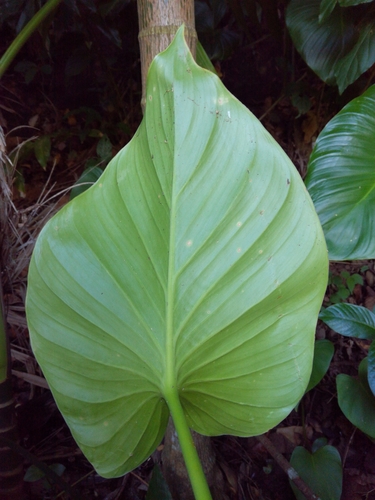
(c) Langzi, some rights reserved (CC BY-NC), uploaded by Langzi
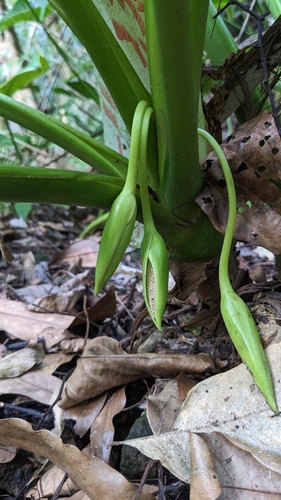
(c) Cheng-Te Hsu, some rights reserved (CC BY), uploaded by Cheng-Te Hsu

(c) chuenliang, some rights reserved (CC BY-NC)
What to Eat
Edible parts: Tubers, Root
The tubers and roots are edible.
Known Hazards
Where to Find It
It is a tropical plant.
Asia, Indonesia, SE Asia,
How to Identify
A tropical herb in the Araceae family.
Nutrition Score: 12/100
| Part | Moisture | kJ | kcal | Protein | Vit A | Vit C | Iron | Zinc |
|---|---|---|---|---|---|---|---|---|
| Tubers | 69.8 | — | — | 2.1 | — | 1.1 | — | — |
How to Grow
The base of the petioles, when pulled off, has a very sweet chewing-gum odour especially when the tissues are crushed.
Medicinal Uses
The rhizomes are used as an embrocation to treat rheumatism. The leaves are vulnerary.
Other Uses
The large leaves are used for wrapping food.
Wikipedia
Source ↗Homalomena philippinensis is a species of flowering plants in the family Araceae. It is native to the Philippines and Orchid Island in Taiwan. The plant has large heart-shaped leaves that grow up to around 1 m (3.3 ft) tall from an underground corm. It grows at low elevations usually in forests and along bodies of water. It is commonly known as payau or payaw, alupayi or alopayi, salet, or tahig, among other names. H. philippinensis is commonly grown as an ornamental plant. The petioles of the leaves have a sweet chewing gum scent when crushed. The leaves are used in Philippine folk medicine and for wrapping food in Philippine cuisine.
Names & Synonyms
References (1)
- Suwardi, A. B., 2018, Nutritional Evaluation of Some Wild Edible Tuberous Plants as Alternative Foods. Innovare Journal of Food Science, Vol. 6, Issue 2.


