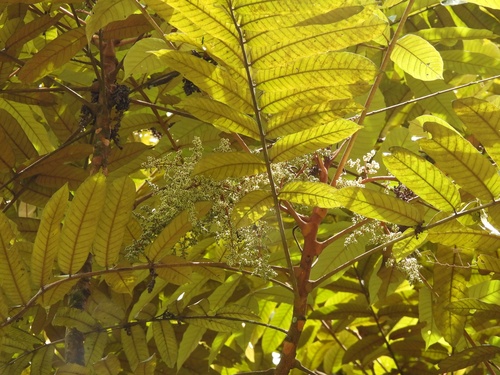
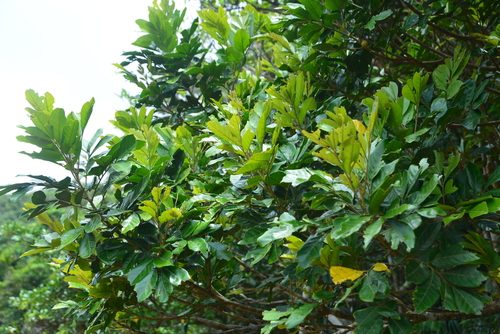
Soymida febrifuga
(Roxb.) A. Juss.

(c) Aditya Rao, some rights reserved (CC BY), uploaded by Aditya Rao
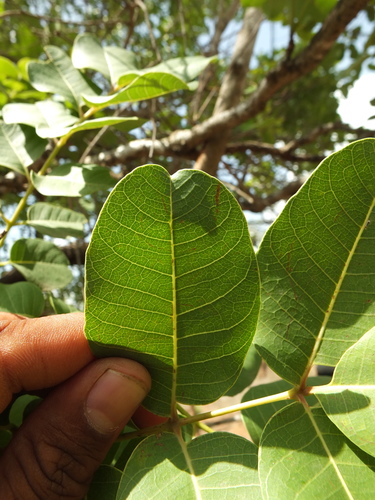
(c) Siddarth Machado, some rights reserved (CC BY), uploaded by Siddarth Machado
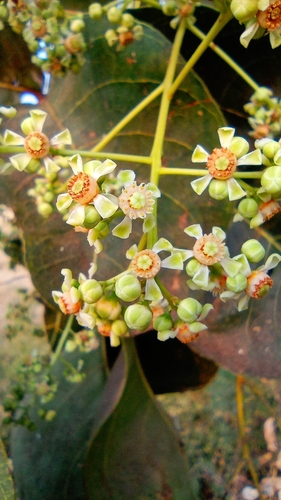
(c) Sandeep sakhare, some rights reserved (CC BY-NC), uploaded by Sandeep sakhare
What to Eat
Edible parts: Bark
The fruit is said to be edible.
Where to Find It
It is a tropical plant.
Asia, India,
How to Identify
A tree.
How to Grow
A plant of dry to moist, mainly lowland areas in the tropics, where it is found at elevations up to 900 metres. It grows best in areas where annual daytime temperatures are within the range 32 - 40°c, though it can tolerate 10 - 47°c. It prefers a mean annual rainfall of 800 - 1,300mm, tolerating 600 - 1,500mm, growing in areas with a distinct dry season. Requires a sunny position. Succeeds in most well-drained soils. Prefers a pH in the range 5.5 - 6.5, but tolerates 4.5 - 7.8.
Medicinal Uses
The deep red bark is antiperiodic, antipyretic, very astringent and a bitter tonic. The bark is said to be much inferior to cinchona bark, but to be a good substitute for oak bark. A decoction is used in the treatment of general debility, diarrhoea and dysentery, dyspepsia, dysmenorrhoea; and is also often used as a febrifuge instead of quinine (Cinchona spp.) by local people. It is said to be an efficient remedy for the dangerous jungle fever of India, when quinine produces no effect. It has also been employed successfully against typhus fever and has proven to be effective in treating bad cases of gangrene. A decoction of the bark forms a good substitute for oak-bark, and is well suited for use as gargles, vaginal injections and enemas; it is also used as a gargle in the treatment of stomatitis, and is applied topically to rheumatic swellings. It is used in the treatment of fractures and snake bites. The plant contains mainly tetranor-triterpenoids and flavonoids. The heartwood gave febrifugine A and B, febrinins A and B; the flavonoids naringenin, quercetin, myricetin and dehydromyricetin. The root heartwood yielded sitosterol, obtusifoliol, syringetin and dihydrosyringetin. The bark contains tetranor-triterpenoids with a modified furan ring. A petroleum ether extract of the bark yielded a steroid, methyl angolensate; an ether extract yielded a steroid glycoside..
Other Uses
A strong, red fibre is obtained from the bark. It is made into ropes. The bark is a source of tannins[46. 146, ]. A beautiful clear gum is obtained from the bark in large pieces. It affords a good mucilage. The heartwood is a very dark red-brown, the sapwood is thin and whitish. The wood is close-grained; extremely hard; very durable. It is somewhat cross-grained, making it difficult to plane. The wood has a beautiful, close, compact grain, giving a fine surface from the tool, and is a valuable and attractive decorative furniture wood, suitable for all high-class purposes. It is suitable for house building, furniture, pestles, grain mills, carving etc.
Names & Synonyms
Ruhen
References (1)
- Kahlon, L. K. & Singh, R., 2019, Traditional knowledge & Dynamics of edible plants of primitive tribal group ‘Paudi Bhuyan’ with changing demography migration patterns in Northern Odisha. Indian Journal of Traditional Knowledge Vol 18(1), pp 7-15