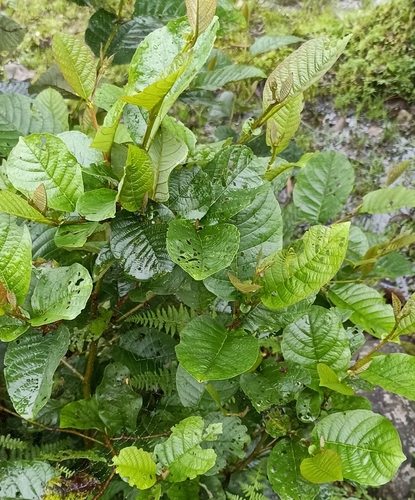
Corylus maxima
Mill.
Filbert tree, Giant filbert, Purple-leaf hazel

(c) Fritz Geller-Grimm, some rights reserved (CC BY-SA)

(c) Manuel M. V., some rights reserved (CC BY)

(c) Douglas Goldman, some rights reserved (CC BY-SA), uploaded by Douglas Goldman
What to Eat
Edible parts: Nuts, Seeds
The large, well-flavoured seeds are rich in oil and can be eaten raw, used in baking (cakes, pies, breads), or processed into a plant milk. Seeds ripen in mid to late autumn and will likely need protection from squirrels. Stored unshelled in a cool place, they keep for at least 12 months. An edible oil is also obtained from the seed.
Where to Find It
It is a temperate and Mediterranean climate plant. It is best in deep, well-drained soil. It needs a protected, sunny position. It is resistant to frost but damaged by drought. It suits hardiness zones 5-9.
Australia, Balkans, Caucasus, Europe*, Greece, Mediterranean, Slovenia, Turkey, Türkiye, Yugoslavia,
How to Identify
It is a large shrub or tree. It grows 9 m tall. It can spread to 4.5 m wide. The leaves are large and heart shaped. They are mid green. The young twigs have sticky hairs. There is a much longer, tubular husk enclosing the nut. The brown nuts are large and egg shaped. Corylus maxima and Corylus avellana often form hybrids.
How to Grow
An easily grown plant, it succeeds in most soils, but is in general more productive of seeds when grown on soils of moderate fertility. It does less well in rich heavy soils or poor ones. Does well in a loamy soil. Very suitable for an alkaline soil, but it dislikes very acid soils. Plants are fairly wind tolerant. A very hardy plant but the male flowers can be damaged by heavy frosts at flowering time. The filbert is often cultivated for its edible seeds, there are many named varieties. It has often been hybridized with C. avellana in breeding programmes. Plants are self-fertile but a more certain crop is obtained if more than one cultivar is grown. The main difference between cob nuts and filberts is that the husk of a filbert is longer than the seed and often completely encloses it, whilst the husk on a cob nut is shorter than the seed. Squirrels are a major pest of this plant, often decimating the crop of nuts. Members of this genus bear transplanting well and can be easily moved even when relatively large.
Propagation: Sow seed as soon as it is harvested in autumn in a cold frame; it germinates in late winter or spring. Stored seed should be pre-soaked in warm water for 48 hours, then given 2 weeks of warm stratification followed by 3–4 months of cold stratification. Germination takes 1–6 months at 20°C. Prick seedlings into individual pots when large enough to handle and grow on in a cold frame or sheltered spot through their first winter. Plant out into permanent positions in late spring or early summer. Layering in autumn is easy and takes about 6 months. Suckers can be divided in early spring and planted straight into permanent positions.
Medicinal Uses
None known
Other Uses
The seed contains up to 65% of a non-drying oil used in paints and cosmetics. Whole seeds can be used to polish and oil wood — a very easy and effective method. Plants can be grown as a tall hedge, though they should be left untrimmed or only lightly trimmed if seed production is wanted. The wood is soft, easy to split, not very durable, and beautifully veined; it is used for inlay work, small furniture items, hurdles, wattles, basketry, and pea sticks. Twigs are traditionally used as dowsing rods. The wood yields a good-quality charcoal used by artists.
Wikipedia
Source ↗Corylus maxima, the filbert, is a species of hazel in the birch family. It is native to Eurasia and produces an edible nut.
Other Information
It is cultivated.
Notes
There are about 15 Corylus species.
Names & Synonyms
Aveleira, Avellana, Coudrier, European filbert, Haselnuss, Haselstrauch, Lambert's filbert, Lambert's nut, Lombardy-nut, Nocciola, Noisetier
References (31)
- Bianchini, F., Corbetta, F., and Pistoia, M., 1975, Fruits of the Earth. Cassell. p 192
- Bodkin, F., 1991, Encyclopedia Botanica. Cornstalk publishing, p 288
- Brickell, C. (Ed.), 1999, The Royal Horticultural Society A-Z Encyclopedia of Garden Plants. Convent Garden Books. p 305
- Brouk, B., 1975, Plants Consumed by Man. Academic Press, London. p 216
- Cundall, P., (ed.), 2004, Gardening Australia: flora: the gardener's bible. ABC Books. p 422
- Dogan, Y., et al, 2015, Of the importance of a leaf: the ethnobotany of sarma in Turkey and the Balkans. Journal of Ethnobiology and Ethnomedicine, 11:56
- Etherington, K., & Imwold, D., (Eds), 2001, Botanica's Trees & Shrubs. The illustrated A-Z of over 8500 trees and shrubs. Random House, Australia. p 232
- Facciola, S., 1998, Cornucopia 2: a Source Book of Edible Plants. Kampong Publications, p 83
- FAO, 1995, Edible Nuts. Non Wood Forest Products 5.
- Flowerdew, B., 2000, Complete Fruit Book. Kyle Cathie Ltd., London. p 198
- Gard. dict. ed. 7: Corylus no. 3. 1759
- Hedrick, U.P., 1919, (Ed.), Sturtevant's edible plants of the world. p 221 (As Corylus tubulosa)
- Heywood, V. H. & Zohary, D.,1995, A Catalogue of the Wild Relatives of Cultivated Plants Native to Europe. Flora Mediterranea 5 - 1995, p 383
- http://en.hortipedia.com
- Kiple, K.F. & Ornelas, K.C., (eds), 2000, The Cambridge World History of Food. CUP p 1784
- Kremer, B.P., 1995, Shrubs in the Wild and in Gardens. Barrons. p 164
- Lord, E.E., & Willis, J.H., 1999, Shrubs and Trees for Australian gardens. Lothian. p 219
- Lyle, S., 2006, Discovering fruit and nuts. Land Links. p 157
- Masefield,
- Menninger, E.A., 1977, Edible Nuts of the World. Horticultural Books. Florida p 13
- Morley, B. & Everard, B., 1970, Wild Flowers of the World. Ebury press. Plate 12
- Plants for a Future, The Field, Penpol, Lostwithiel, Cornwall, PL22 0NG, UK. http://www.scs.leeds.ac.uk/pfaf/
- Ryan, S., 2008, Dicksonia. Rare Plants Manual. Hyland House. p 19
- Small, E., 2009, Top 100 Food Plants. The world's most important culinary crops. NRC Research Press. p 264
- Smith, P.M., 1979, Filbert, in Simmonds, N.W., (ed), Crop Plant Evolution. Longmans. London. p 305
- Sp. pl. 4(1):470. 1805 (As Corylus tubulosa)
- USDA, ARS, National Genetic Resources Program. Germplasm Resources Information Network - (GRIN). [Online Database] National Germplasm Resources Laboratory, Beltsville, Maryland. Available: www.ars-grin.gov/cgi-bin/npgs/html/econ.pl (10 April 2000)
- van Wyk, B., 2005, Food Plants of the World. An illustrated guide. Timber press. p 153
- Wickens, G.E., 1995, Edible Nuts. FAO Non-wood forest products. FAO, Rome. p 18, 118
- Young, J., (Ed.), 2001, Botanica's Pocket Trees and Shrubs. Random House. p 280
- Zeven, A. C. & de West, J. M. J., 1982, Dictionary of cultivated plants and their regions of diversity. Wageningen. p 89