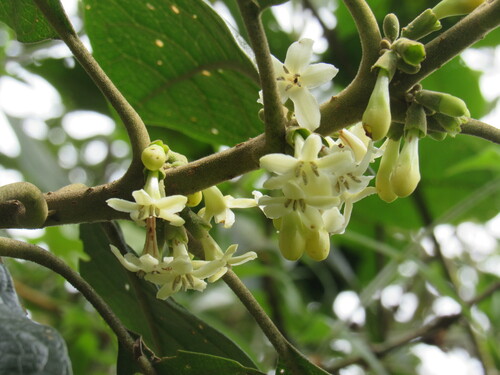
Thymus cilicicus
Boiss. & Balansa

(c) Frank Fritzlar, some rights reserved (CC BY-NC)

(c) Frank Fritzlar, some rights reserved (CC BY-NC)

(c) Frank Fritzlar, some rights reserved (CC BY-NC)
What to Eat
Edible parts: Leaves - tea, Leaves - spice
The lemon-scented leaves are used as a flavouring in food.
How to Identify
Evergreen shrub reaching 20cm tall and 40cm wide. Flowers July to August with hermaphroditic blooms pollinated by bees, flies, and butterflies. Hardy to UK zone 7. Prefers full sun and well-drained neutral to basic soil; tolerates both dry and moist conditions. Cannot grow in shade.
How to Grow
Prefers a light, well-drained calcareous soil and a sunny position. This species thrives in stony situations. Plants tolerate occasional walking on and can be grown in cracks in paths, they also succeed on walls. Thymes dislike wet conditions, especially in the winter. A layer of gravel on the soil around them will help protect the foliage from wet soils. Plants are hardy to at least -10°c. The flowers are rich in nectar and are very attractive to honey bees. This is a very difficult genus taxonomically, the species hybridize freely with each other and often intergrade into each other.
Propagation: Sow seed in spring in a cold frame, or in autumn in a greenhouse. Surface sow or barely cover the seed, as germination can be erratic. Prick seedlings into individual pots when large enough to handle and grow on under glass for at least their first winter, then plant out in late spring or early summer after the last expected frosts. Divide plants in spring or autumn; larger divisions can go directly into permanent positions, while smaller ones are best potted up and grown on in light shade until well established, then planted out in summer or the following spring. Take cuttings of young shoots 5–8cm with a heel in May/June in a frame, or half-ripe cuttings 5–8cm with a heel in July/August in a frame. Layering is also possible.
Medicinal Uses
The leaves, and particularly their essential oil, are strongly antiseptic, deodorant, and disinfectant. The plant can be used fresh year-round, or harvested as it comes into flower for distillation of the oil or drying for later use.
Other Uses
An essential oil is obtained from the leaves.
Wikipedia
Evergreen shrub reaching 20cm tall and 40cm wide. Flowers July to August with hermaphroditic blooms pollinated by bees, flies, and butterflies. Hardy to UK zone 7. Prefers full sun and well-drained neutral to basic soil; tolerates both dry and moist conditions. Cannot grow in shade.
Names & Synonyms
Kilcik kekigi, Limonkekigi
References (2)
- Ertug, F, Yenen Bitkiler. Resimli Türkiye Florası -I- Flora of Turkey - Ethnobotany supplement
- Gurdal, B. & Kultur, S., 2014, The edible and miscellaneous useful plants in Marmaris (Southwest Turkey). İstanbul Ecz. Fak. Derg. / J. Fac. Pharm. Istanbul 44(1) 2014 pp.69-78