Daphne mucronata
Royle
(c) skhussain, some rights reserved (CC BY-NC)

(c) Salman Baloch, some rights reserved (CC BY-NC)
(c) Arya Aras, some rights reserved (CC BY-NC)
What to Eat
Edible parts: Fruit
The fruit are eaten.
Where to Find It
It is a temperate plant. It grows between 800-3,000 m above sea level in Pakistan. It is often near rivers.
Afghanistan, Africa, Asia, Himalayas, Iran, Middle East, North Africa, Pakistan,
How to Identify
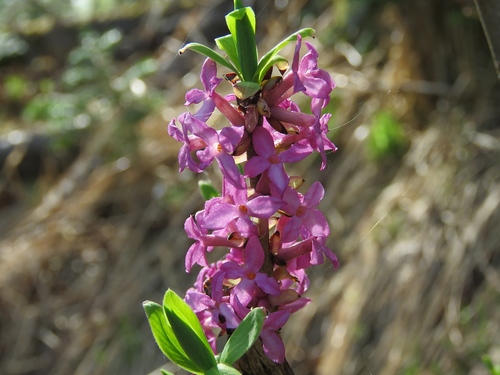
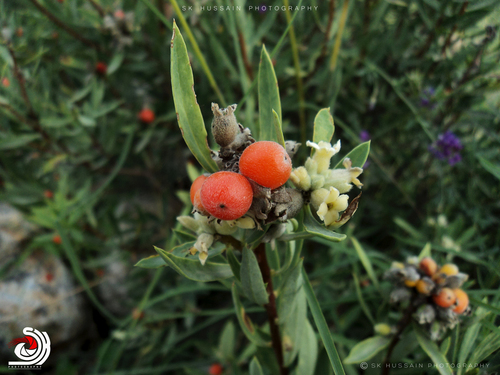
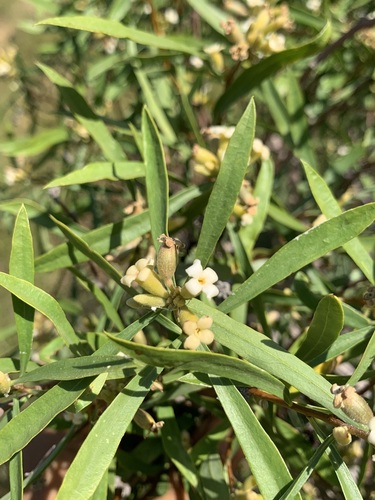
A shrub. It grows 2.5 m tall. The branches are slender and pale green. The leaves are alternate and scattered. They are 3-6 cm long by 0.4-1 cm wide. The flowers are white and in groups in the axils of leaves or at the ends of branches. The fruit are a flattened round shape and 1 cm long. They are hairy and orange.
Wikipedia
Source ↗Daphne mucronata is a shrub, of the family Thymelaeaceae. It is native to western Asia, ranging from eastern Turkey to the Arabian Peninsula, Iran, Afghanistan, Pakistan, and the western Himalayas.
Names & Synonyms
Alef, Kheshk, Khoshak, Kutilal, Kuttilal, Laighonai, Lovomekeen, Pipal, Toye
References (4)
- Barkatullah, et al, 2009, Ethnobotanical studies of plants of Charkotli Hills, Batkhela District, Malakand, Pakistan. Front. Biol. China 2009, 4(4): 539–548
- Haj, F., et al, 2012, Species Diversity and Ethno Botanical Classes of the Flora of Allai Valley District Battagram Pakistan. International Journal of Plant Research 2012, 2(4): 111-123
- Jabeen, A., et al, 2009, Indigenous uses of economically important flora of Margallah Hills National Park, Islamabad, Pakistan. African Journal of Biotechnology Vol. 8 (5), pp. 763-784
- Khan, W., et al, 2013, Ethnomedicinal plants of Kakul Hills, District Abbottabad, KPK, Pakistan.