Dacryodes excelsa
Vahl
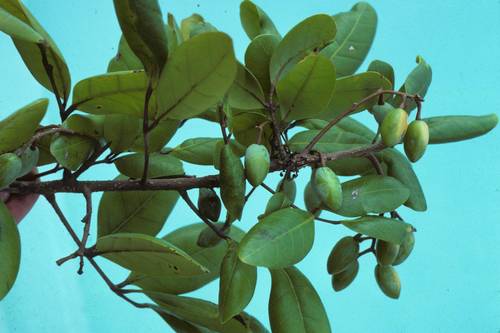
(c) Smithsonian Institution, National Museum of Natural History, Department of Botany, some rights reserved (CC BY-NC-SA)

(c) Armando Feliciano, some rights reserved (CC BY-NC), uploaded by Armando Feliciano

(c) Octavio Rivera Hernández, some rights reserved (CC BY-NC), uploaded by Octavio Rivera Hernández
What to Eat
Edible parts: Fruit ?
We have seen no records regarding the edibility of this fruit, but most, if not all, members of the genus have a fruit with a soft, sweet flesh and are potentially edible. The flesh of the fruits in this genus usually adheres very strongly to the seed. When placed in hot (but not boiling) water at around 60 - 85°c the fruit softens and swells and all the flesh then slides easily off the seed.
Where to Find It
It is a tropical plant.
Caribbean, Lesser Antilles, Puerto Rico, West Indies,
How to Identify
A tropical tree in the Burseraceae family that produces fruit of uncertain edibility.
How to Grow
A tree of low to medium elevations in the tropics, it is found in areas with a mean temperature in the range of 21 - 25°c, and a mean annual precipitation range from 2,000 - 4,000 mm. Precipitation is generally abundant except for about 3 months of the year, when it may drop to about 75 mm per month. Grows in the wild on deep, red, clay soils derived from igneous rock. Typically these soils are stony, often with large boulders, and internal drainage is good. The soil is usually acid, with a pH of around 4.5 - 5.5. Seedlings are very tolerant of shade, but plants need more light as they grow older. At 9 years, trees were 3.0 - 4.3 metres in height and 3.8 to 5.0 cm in dbh. The trees are deep rooted and able to withstand the numerous hurricanes of the Caribbean area. Large tabonuco trees tend to be concentrated on upper slopes and ridges, where they may form nearly pure groups whose roots are grafted, thus forming a tree union or clumps of trees. Presumably this reflects the better drainage of soils at such locations or the superior anchorage against hurricane winds that the prominent boulders may offer. Significantly superior diameter growth rates of tabonuco on ridges as compared to swales have been reported. A dioecious species, both male and female forms need to be grown if seed is required.
Propagation: Seed - the seed has a short viability and needs to be sown as soon as possible. Germination is epigeal and, in the wild, takes place within a few days under humid, shady conditions. Under direct exposure to the sun, germination is less than in the shade, 11% compared to 28% in one test. Under shady, nursery conditions, seedlings attained a height of 22 cm in 6 months. Like many other large-seeded tree species, tabonuco does not survive bare root transplanting.. In contrast, 85 percent survival has been attained by the use of containers with an intact ball of earth about the roots.
Medicinal Uses
A resin obtained from the wood has medicinal uses.
Other Uses
The bark is smooth, light gray to nearly white, and often scarred at the base of the tree from gashes made to secure a fragrant resin, which is used for making candles and torches; incense and for medicinal purposes. A clear, fragrant inflammable resin exudes from points of damage on the tree. It hardens and turns white on exposure to the air. The heartwood is a uniform pale brown with a purplish cast when first cut; it turns to a pinkish brown when seasoned and a lustrous brown on exposure. The narrow band of sapwood, an unattractive greyish colour, is not clearly demarcated from the heartwood. The texture is fine to medium and uniform, it is generally somewhat finer textured than mahogany, which it resembles superficially. The lustre is high and sometimes satiny in appearance. Growth rings are not distinct, and seasoned wood lacks any distinctive odour or taste. The wood is moderately heavy, but only slightly resistant to decay. The timber is easy to work with some tendency to dull saws and other cutting edges, because of the accumulated silica in the wood. When sharp cutting edges are maintained, the wood finishes smoothly and takes glue and all finishes effectively. It is a good wood for turning and holding nails. The wood is used in Puerto Rico principally for furniture and cabinetmaking in the urban areas and for general construction and carpentry in the rural areas. In St. Lucia and Dominica it is used for crates, shingles, small boat building and furniture. The wood has sufficient strength and attractiveness to merit its use in place of yellow birch, mahogany, and other cabinet woods. In Puerto Rico it is often stained a dark mahogany colour and sold as mahogany. Rails and posts of mahogany beds are frequently made of the wood, stained dark to hide its identity. This is the result of its reputation of being very susceptible to termite attack in comparison to mahogany’s known resistance to termites. The wood is considered suitable for veneer.
Wikipedia
Source ↗Dacryodes excelsa is a tree native to Puerto Rico with a habitat that extends into the Lesser Antilles in the Caribbean region. Its English vernacular names include gommier and candlewood. Its Spanish common name is tabonuco. According to Richards, "it is the most conspicuous large emergent tree" in the Luquillo mountains of Puerto Rico. It is also found in Toro Negro State Forest, in Puerto Rico Cordillera Central. Dacryodes excelsa grows to around 115 feet (35 m), and grows best in soil with a PH of 4.5–5.5.


