Leonotis leonurus
(L.) R. Br.
Lion's ear, Narrow-leaved leonotis
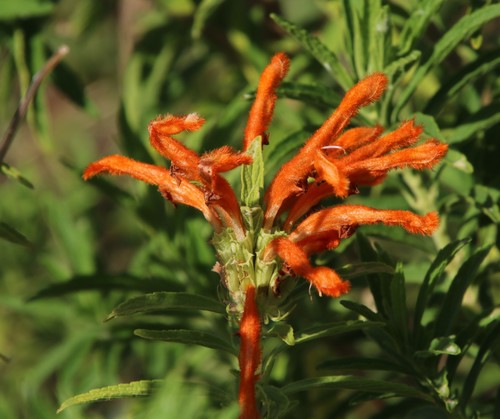
(c) Tony Rebelo, some rights reserved (CC BY-SA), uploaded by Tony Rebelo
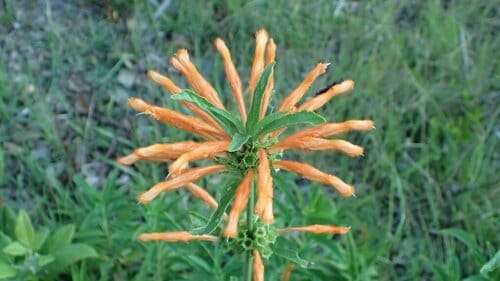
(c) Marian Oliver, some rights reserved (CC BY-NC)

(c) Chris Lloyd, some rights reserved (CC BY-NC), uploaded by Chris Lloyd
What to Eat
Edible parts: Flower - nectar, Leaves, Stem
The nectar is sucked from the flowers. The leaves are eaten as a vegetable.
Where to Find It
It is a subtropical plant.
Africa, Australia, Georgia, South Africa, Southern Africa, Tasmania,
How to Identify
A shrub. It grows 2-5 m tall. It forms branches from a thick woody base. They are densely hairy. The leaves are 5-10 cm long by 1-2 cm wide. They have teeth on the upper half. The leaves are green and rough on the upper surface and hairy underneath. The flowers are in groups or 3-11. The small nuts are 5-6 mm long by 1.6-1.9 mm wide.
How to Grow
A plant of subtropical to tropical climates. Plants can tolerate some frost. Very easily grown, plants are not particularly fussy about soil type, and are easily grown in average, medium, well-drained soils in full sun. Tolerates some light shade. Plants like regular moisture, more especially during the growing season. Young plants grow away rapidly and can reach a height of 1 - 1.8 metres in their first year from seed. Plants can be pruned right back to ground level in their dormant season to encourage lots of new growth. The flowers produce copious nectar which attracts birds, bees and butterflies.
Propagation: Seed - no pre-treatment is necessary. Seed can be sown in situ, but is best in containers. Germination is usually fast and good. Seedlings grow away quickly and should be potted up as soon as they are large enough to handle. Plant out into their permanent positions when 15cm tall. Cuttings may be taken in spring from overwintered plants or from garden plants in summer for overwintering. Division of large clumps.
Medicinal Uses
Marrubiin has both antioxidant and cardioprotective properties and has shown to significantly improve myocardial function. Docosatetraenoylethanolamide (DEA) is a cannabinoid that acts on the cannabinoid (CB1) receptor which has been found in the whole flower extract of the putative variety Leonotis leonurus var. albiflora. Leonotis leonurus contains several labdane diterpene–based compounds such as Hispanolone, Leonurun, Leonurine and Leoleorins. C-N Leonurine (also known as SCM-198 in research) is a pseudoalkaloid that has been isolated from Leonotis leonurus, Leonotis nepetifolia, Leonurus japonicus, Leonurus cardiaca (motherwort), Leonurus sibiricus, as well as other plants of family Lamiaceae. Leonurine is easily extracted into water. One experimental animal study suggests that the aqueous leaf extract of Leonotis leonurus possesses antinociceptive, antiinflammatory, and hypoglycemic properties. An animal study in rats indicated that in high doses, lion's ear has significant toxicological adverse effects on organs, red blood cells, white blood cells, and other important bodily functions. Acute toxicity tests in animals caused death for those receiving a 3200 mg/kg dose. A 1600 mg/kg extract led to changes in red blood cells, haemoglobin concentration, mean corpuscular volume, platelets, and white blood cells.
Other Uses
The plant has been grown as a hedge in some parts of the world.
Wikipedia
Source ↗Leonotis leonurus, also known as wild dagga and lion's ear, is a plant species in the mint family Lamiaceae. It is a broadleaf evergreen shrub, native to South Africa, where it is very common, with a wide altitudinal range from 5 m up to 1980 m. It is known for its medicinal properties. The main psychoactive component of Leonotis leonurus is hypothesized to be related to the presence of leonurine or labdanes; Leonotis leonurus has been confirmed to contain leonurine according to peer reviewed journal published phytochemical analysis. Like other plants in the mint family, it also contains marrubin. The word "dagga" comes from Afrikaans, and derives in turn from the Khoikhoi "dachab". The word "dagga" has been extended to include cannabis in Afrikaans and South African English, so the use of "wild" serves to distinguish Leonotis leonurus from this.
Names & Synonyms
Leonit'isi, Manbossie, Mununzu, Vleidagga, Wildedagga
References (5)
- Bussman, R. W., et al, 2021, Unity in diversity—food plants and fungi of Sakartvelo (Republic of Georgia), Caucasus. Journal of Ethnobiology and Ethnomedicine (2021) 17:72 p 9
- De Vynk, J. C., et al, 2016, Indigenous edible plant use by contemporary Khoe-San descendants of South Africa's Cape South Coast. South African Journal of Botany. 102 (2016) 60-69
- Magwede, K., van Wyk, B.-E., & van Wyk, A. E., 2019, An inventory of Vhavenḓa useful plants. South African Journal of Botany 122 (2019) 57–89
- Ruiters-Welcome, A. K., 2019, Food plants of southern Africa. Ph.D. thesis. Univ. of Johannesburg p 70
- Welcome, A. K. & Van Wyk, B.-E., 2019, An inventory and analysis of the food plants of southern Africa. South African Journal of Botany 122 (2019) 136–179