Tritonia squalida
(Aiton) Ker Gawl.
IridaceaeRoots
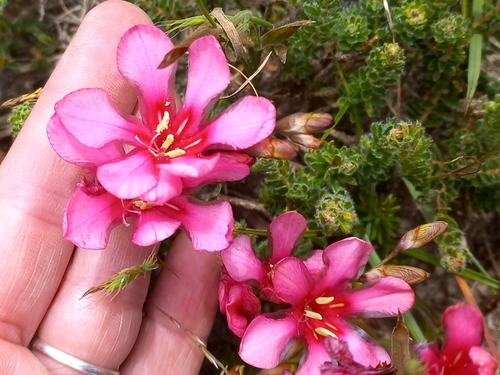
iNaturalist · cc-by-nc
(c) Martjie Fia Fourie, some rights reserved (CC BY-NC), uploaded by Martjie Fia Fourie
(c) Martjie Fia Fourie, some rights reserved (CC BY-NC), uploaded by Martjie Fia Fourie
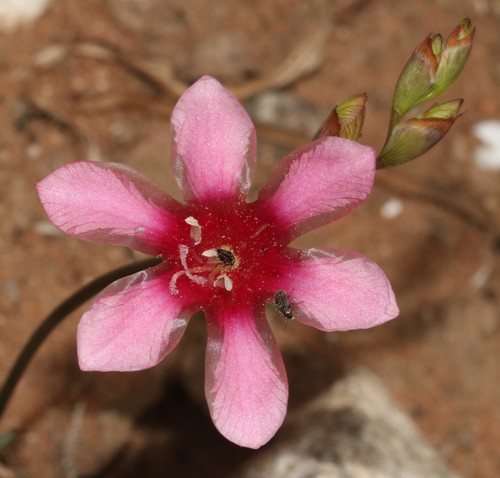
iNaturalist · cc-by-sa
(c) Brian du Preez, some rights reserved (CC BY-SA), uploaded by Brian du Preez
(c) Brian du Preez, some rights reserved (CC BY-SA), uploaded by Brian du Preez
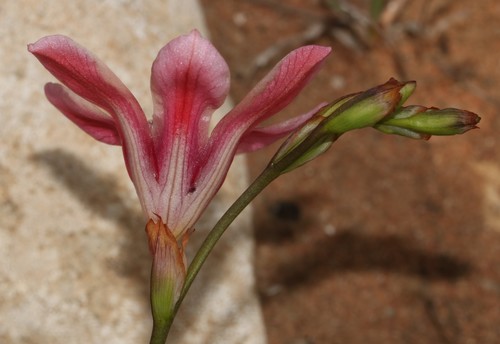
iNaturalist · cc-by-sa
(c) Brian du Preez, some rights reserved (CC BY-SA), uploaded by Brian du Preez
(c) Brian du Preez, some rights reserved (CC BY-SA), uploaded by Brian du Preez
What to Eat
Edible parts: Corm, Root
The corm and roots are edible portions.
Where to Find It
It is a subtropical plant. It grows on limestone outcrops.
Africa, Australia, South Africa*, Southern Africa,
Countries: Angola, Australia, Burkina Faso, Burundi, Benin, Botswana, Congo (DRC), Central African Republic, Congo (Republic), Cote d'Ivoire, Cameroon, Cape Verde, Djibouti, Algeria, Egypt, Eritrea, Ethiopia, Gabon, Ghana, Gambia, Guinea, Equatorial Guinea, Guinea-Bissau, Kenya, Comoros, Liberia, Lesotho, Libya, Morocco, Madagascar, Mali, Mauritania, Mauritius, Malawi, Mozambique, Namibia, Niger, Nigeria, Rwanda, Seychelles, Sudan, Sierra Leone, Senegal, Somalia, South Sudan, Sao Tome & Principe, Eswatini, Chad, Togo, Tunisia, Tanzania, Uganda, South Africa, Zambia, Zimbabwe
How to Identify
A corm plant. It grows 25-40 cm tall. The corm is 2.5 cm across. The leaves are sword shaped. They are 8-40 cm long by 8-24 mm wide. There are 4-10 flowers. The flowers are pink or purple.
Wikipedia
Source ↗Tritonia squalida is a tuberous geophyte belonging to the genus Tritonia. The species is endemic to the Western Cape and occurs from Riversdale to Albertinia and Stilbaai. The species has lost its habitat to crop cultivation around Albertina and urban development at Albertina and Stilbaai. Invasive plants are also a threat.
Names & Synonyms
Kalkoentjie
Ixia hyalina DC.Ixia similis Salisb.Ixia squalida AitonTritonia magniflora Dehnh.Tritonia pulchella Dehnh.and others
References (3)
- De Vynk, J. C., et al, 2016, Indigenous edible plant use by contemporary Khoe-San descendants of South Africa's Cape South Coast. South African Journal of Botany. 102 (2016) 60-69
- Ruiters-Welcome, A. K., 2019, Food plants of southern Africa. Ph.D. thesis. Univ. of Johannesburg p 69
- Welcome, A. K. & Van Wyk, B.-E., 2019, An inventory and analysis of the food plants of southern Africa. South African Journal of Botany 122 (2019) 136–179


