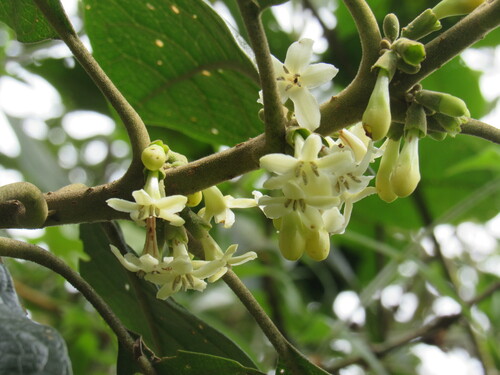
Prostanthera lasianthos
Labill.
Victorian Christmas bush
(c) Reiner Richter, some rights reserved (CC BY-NC-SA), uploaded by Reiner Richter
(c) Reiner Richter, some rights reserved (CC BY-NC-SA), uploaded by Reiner Richter
(c) Reiner Richter, some rights reserved (CC BY-NC-SA), uploaded by Reiner Richter
What to Eat
Edible parts: Leaves - flavouring
The dried leaves are used as a mint flavouring, though should only be used in small amounts.
Known Hazards
How to Identify
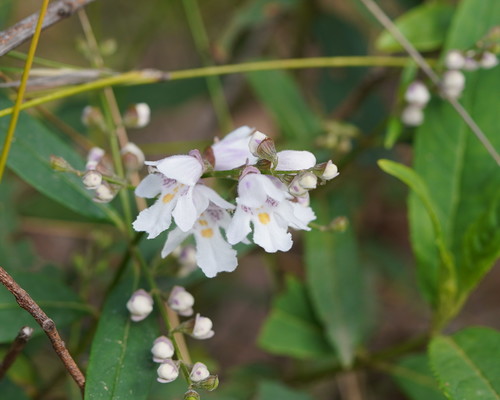
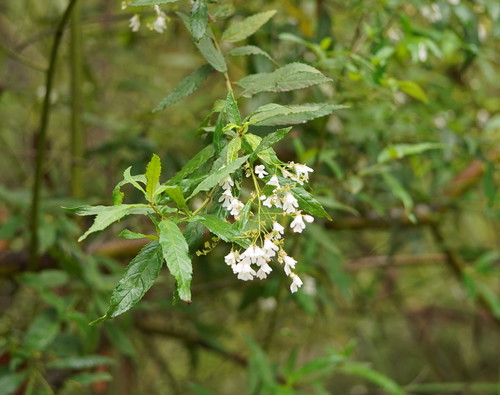
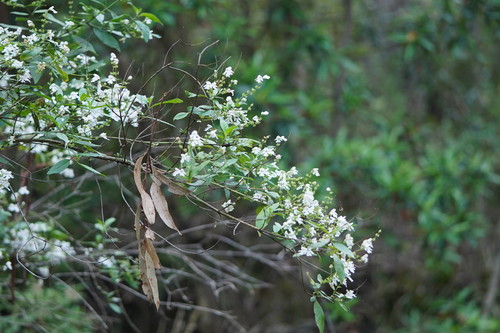
A shrub or small tree. It grows 2-8 m tall. The leaves are smooth. The stems are green and square. The leaves are narrowly oval and 5-10 cm long by 1-3 cm wide. They are dark green on top and paler green underneath. The flowers occur in groups. The flowers are irregular with 2 lobes on top and 3 lower down.
Wikipedia
Source ↗Prostanthera lasianthos, commonly known as the Victorian Christmas bush or coranderrk , is a large shrub or small tree of the mint family, Lamiaceae, which is native to Queensland, New South Wales, Victoria and Tasmania in Australia. It grows up to 10 m (35 ft) high but is usually much less and is found in wet sclerophyll forests, often beside creeks. Its flowers, which appear in profuse sprays, are about 2 cm long and white or pale lilac, with purple and orange blotches in the throat. They appear in late spring and summer, and specifically around Christmas time in Victoria. The fragrant, toothed leaves are 4 to 12 cm (sometimes 15 cm) long and about 1.5 cm wide.
Names & Synonyms
References (1)
- Caton, J.M. & Hardwick, R. J., 2016, Field Guide to Useful Native Plants from Temperate Australia. Harbour Publishing House. p 166