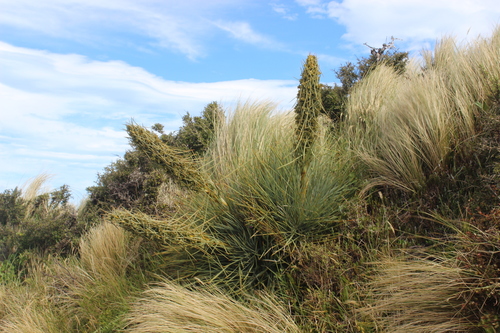
Bupleurum marginatum
Wall. ex DC.
ApiaceaeRoots
iNaturalist · cc-by-nc
(c) liangfern, some rights reserved (CC BY-NC)
(c) liangfern, some rights reserved (CC BY-NC)
iNaturalist · cc-by-nc
(c) liangfern, some rights reserved (CC BY-NC)
(c) liangfern, some rights reserved (CC BY-NC)
What to Eat
Edible parts: Roots
The roots are edible.
Where to Find It
It is a subtropical to temperate plant. In north India it grows between 900-3.600 m above sea level.
Asia, China, Himalayas, India,
Countries: United Arab Emirates, Afghanistan, Armenia, Azerbaijan, Bangladesh, Bahrain, Brunei, Bhutan, China, Georgia, Indonesia, Israel, India, Iraq, Iran, Jordan, Japan, Kyrgyzstan, Cambodia, North Korea, South Korea, Kuwait, Kazakhstan, Laos, Lebanon, Sri Lanka, Myanmar, Mongolia, Maldives, Malaysia, Nepal, Oman, Philippines, Pakistan, Qatar, Saudi Arabia, Singapore, Syria, Thailand, Tajikistan, Timor-Leste, Turkmenistan, Turkey, Taiwan, Uzbekistan, Vietnam, Yemen
How to Identify
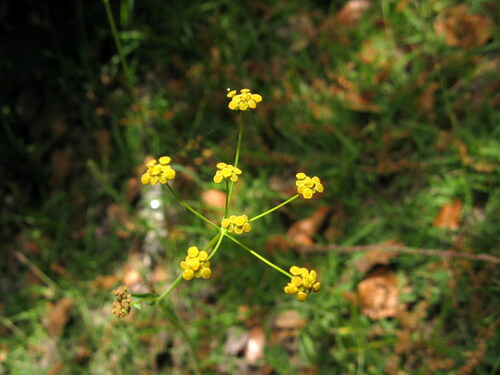
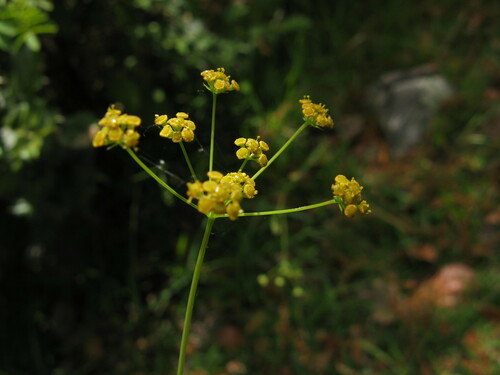
A herb. It grows 25-120 cm tall. It keeps growing from year to year. It has a stout taproot that is softly woody and branched. The stem is rigid and woody at the base. The stem usually has a purple tinge. The leaves are narrowly sword shaped and 10-16 cm long by 0.6-1.4 cm wide. The base tapers and clasps the stem. The flowers are in branched groups. The petals are pale yellow. The fruit is oblong and brown and 3.6-4.5 mm long by 1.8-2.2 mm wide. It has prominent ribs. There is 1 seed.
Names & Synonyms
Kali-zewar, Sipil
Bupleurum falcatum var. marginatum (Wall. ex DC.) C. B. Clarkeand others
References (1)
- Wild edible plants of Himachal Pradesh (As Bupleurum falcatum var. marginatum)