Pandanus whitmeeanus
Martelli,
Samoan pandanus
PandanaceaeFruit

wikimedia · cc-by-sa
Wikimedia Commons - Poyt448, Peter Woodard
Wikimedia Commons - Poyt448, Peter Woodard

wikimedia · cc0
Wikimedia Commons - Howard, W.; Lowe, E. J.
Wikimedia Commons - Howard, W.; Lowe, E. J.
What to Eat
Edible parts: Fruit
The leaves are woven into mats, baskets, and other handicrafts. The fruits are edible.
Where to Find It
It is a tropical plant.
Cook Island, Fiji, New Caledonia, Pacific, Rotuma, Samoa, Tonga, Vanuatu, Wallis & Futuna,
Countries: Australia, Fiji, Micronesia, Kiribati, Marshall Islands, New Caledonia, Nauru, New Zealand, Papua New Guinea, Palau, Solomon Islands, Tonga, Tuvalu, Vanuatu, Samoa
How to Identify
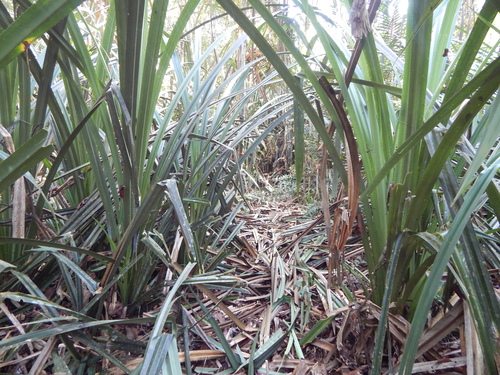
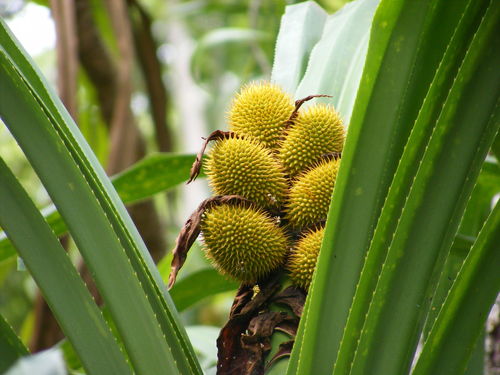
A screwpine tree. It grows 8 m tall. The trunk can be 20 cm across. The leaves are 2 m long. The fruit are nearly round and 21 cm long by 22 cm wide. They are red.
Wikipedia
Source ↗Pandanus whitmeeanus, commonly known as the Samoan pandanus, is a species of Pandanus (screwpine) believed to be native to Vanuatu. It has been introduced to Samoa, Tonga, the Cook Islands, and the Hoorn Islands by Austronesian voyagers. It is also known in Samoan and Tongan as ‘ara ‘āmoa or paogo.
Other Information
It is cultivated.
Names & Synonyms
Paogo
References (4)
- Cook Islands Biodiversity & Natural Heritage. The Cook Islands Natural Heritage Trust. Retrieved 15 January 2019.
- Parham, B. E. V., 1972, Plants of Samoa. New Zealand Department of Scientific and Industrial Research. Information Series. No. 85 p 92
- Wikipedia
- Zeven, A. C. & de West, J. M. J., 1982, Dictionary of cultivated plants and their regions of diversity. Wageningen. p 61