Goodyera rubicunda
(Blume) Lindl.

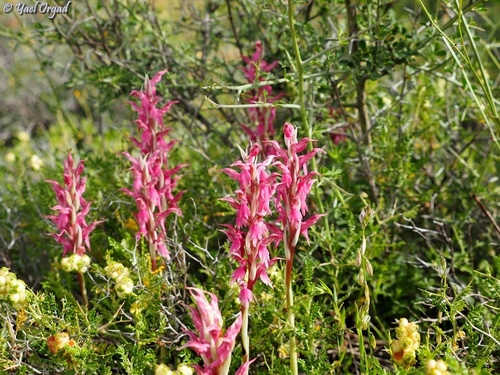
(c) Xing-Xing Tang, some rights reserved (CC BY-NC), uploaded by Xing-Xing Tang

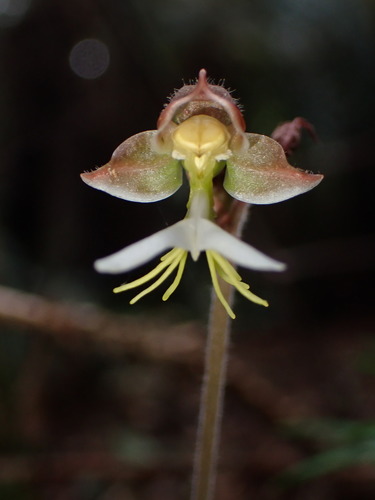
(c) Ben, some rights reserved (CC BY-NC-SA), uploaded by Ben
What to Eat
Edible parts: Bulb, Root, Tuber
The bulbs, roots, and tubers are edible portions of this plant.
Where to Find It
It is a tropical plant.
Asia, China, Indonesia, SE Asia,
How to Identify
An orchid. It grows 30-60 cm tall. The rhizome is stout. The tubers are 10-15 cm across. The stems have 6-10 leaves. These are widely spaced along the stem. They are 9-15 cm long by 4-6 cm wide. The flower stalk is 10-18 cm long and reddish-brown. The flowers are pale yellowish-brown and open widely.
Wikipedia
Source ↗Goodyera rubicunda, commonly known as the giant jewel orchid, is a species of orchid that is native to parts of India, Asia, Southeast Asia, New Guinea, Queensland and some Pacific Islands where it grows in damp forest and rainforest. It has between three and six large, egg-shaped leaves and up to ten dull pink and white resupinate flowers that are hairy on the outside.
Names & Synonyms
References (1)
- Nurfadilah, S., 2020, Utilization of orchids of Wallacea region and implication for conservation. IOP Conf. Series: Earth and Environmental Science 473 (2020) 012063