Craterellus cornucopioides
(Linn. ex Fr.) Persoon
Horn of Plenty, Trumpet of the dead, Black chanterelle
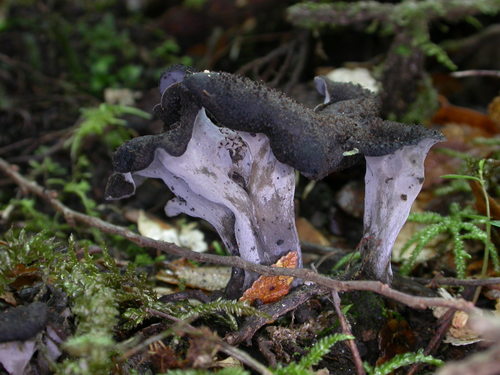
(c) Paul George, some rights reserved (CC BY-NC-SA), uploaded by Paul George
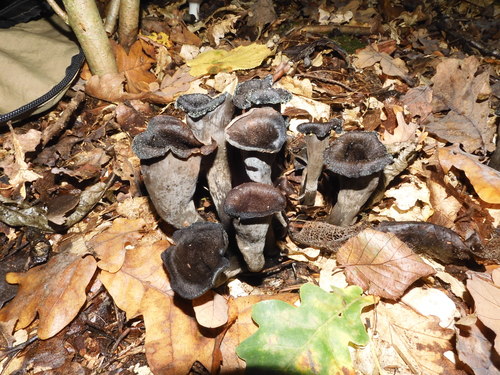
(c) myxograzina, some rights reserved (CC BY-NC)
What to Eat
Edible parts: Fungus, Mushroom, Vegetable
Despite their unpalatable appearance, horns of plenty are edible and choice. According to a Portuguese study, 100 grams of dried C. cornucopioides contain 69.45 g of protein, 13.44 g of carbohydrates (mostly mannitol, a sugar alcohol) and 4.88 g of fat, amounting to 378 calories. They contain fatty acids, primarily of the polyunsaturated variety, as well as phenols, flavonoids and 87 mg of vitamin C. Along with Cantharellus cibarius (golden chanterelles) they are also a significant source of biologically active vitamin B12, containing 1.09–2.65 μg/100 g dry weight. When dried, C. cornucopioides acquires black truffle notes; in this form it can be crumbled as a condiment.
Where to Find It
A tropical plant. It grows in cool humid parts of conifer and broadleaf forests. In Australian rainforests it grows with Nothofagus sp. It suits humid locations. It can grow in Miombo woodland.
Africa, Asia, Australia, Balkans, Benin, Britain, Bulgaria, Canada, Central Africa, Central America, China, Congo DR, Costa Rica, Europe, Finland, France, Himalayas, Hong Kong, Hungary, India, Italy, Malaysia, Mediterranean, Mexico, Nepal, Nigeria, North America, Russia, Scandinavia, SE Asia, Sicily, Slovenia, Spain, Sweden, Switzerland, Turkey, Türkiye, West Africa,
How to Identify
A mushroom. The fruiting bodies are funnel shaped. It is black in colour.
Wikipedia
Source ↗Craterellus cornucopioides is a species of fungus commonly known as the horn of plenty, black chanterelle, black trumpet, or trumpet of the dead. It forms a funnel-shaped grayish mushroom, which is found in Eurasia, North America, and Australia. It is edible.
Other Information
It is sold in local markets in Nepal.
Names & Synonyms
Labajun, Musta torvisieni, Svart trumpetsvamp, Trompette des Mortes
References (24)
- Ambasta, S.P. (Ed.), 2000, The Useful Plants of India. CSIR India. p 145
- Bianchini, F., Corbetta, F., and Pistoia, M., 1975, Fruits of the Earth. Cassell. p 122
- Boa, E. R., Wild edible fungi and their importance to people. FAO Non Wood Forest Products Booklet 17
- Burkill, I.H., 1966, A Dictionary of the Economic Products of the Malay Peninsula. Ministry of Agriculture and Cooperatives, Kuala Lumpur, Malaysia. Vol 1 (A-H) p 687
- Cherubini, A. & Landi, S., Andar per Funghi, Edizioni DieRre, p 56 (As Cantharellus cornucopoides)
- Christensen, M., et al, 2008, Collection and Use of Wild Edible Fungi in Nepal. Economic Botany, 62(1), 2008, pp. 12–23
- Degreef, J., et al, 1997, Edible Mushrooms of the Zambezian woodland area. A nutritional and ecological approach. Biotechnol. Agron. Soc. Envir. 1(3): 221-231
- Denchev, C. M., et al, The wild edible mushrooms in Bulgaria. Bulgarian Academy of Science.
- Dongol, et al, 1995, Edible Mushrooms in Nepal
- Facciola, S., 1998, Cornucopia 2: a Source Book of Edible Plants. Kampong Publications, p 251
- Fuhrer, B., 2005, A field guide to Australian Fungi. Bloomings Books. p 287
- Hall, I. R., et al, 2003, Edible and Poisonous Mushrooms of the World. Timber Press. p 220
- http://www.mykoweb.com/CAF/edible.html
- Joshi, K. and Joshi, A. R., 2008, Ethnobotanical Studies on Some Lower Plants of the Central Development Region, Nepal. Ethnobotanical Leaflets 12:832-40
- Kaufmann, B. et al, 1999, The Great Encyclopedia of Mushrooms. Konemann. p 200
- Lentini, F. and Venza, F., 2007, Wild food plants of popular use in Sicily. J Ethnobiol Ethnomedicine. 3: 15
- Mabey, R., 1973, Food for Free. A Guide to the edible wild plants of Britain, Collins. p 42
- Pace, G., 1998, Mushrooms of the world. Firefly books. p 223
- Pelkonen, R., et al, 2008, Element Concentrations in Wild Edible Mushrooms in Finland. The Finnish Environment 25
- Schneider, E., 2001, Vegetables from Amaranth to Zucchini: The essential reference. HarperCollins. p 171
- See, L. S., et al, 2008, Utilization of Macrofungi by some Indigenous Communities for Food and Medicine in Peninsular Malaysia. Sustainable Forest Management and Poverty Alleviation: Roles of Traditional Forest-related Knowledge IUFRO World Series Volume 21 (v. mediosporus)
- Svanberg, I., & Lindh, H., 2019, Mushroom hunting and consumption in twenty-first century post-industrial Sweden. Journal of Ethnobiology and Ethnomedicine (2019) 15:42
- Vetner, J., 2004, Arsenic content of some edible mushroom species. Eur. Food Res. Technol. 219: 71-74
- www.plantnames.unimelb.edu.au


