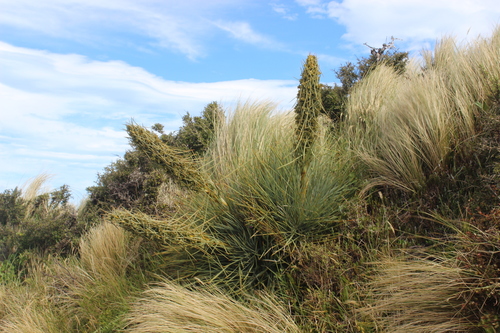
Crithmum maritimum
L.
Samphire, Rock Samphire

(c) Leif Fryle, some rights reserved (CC BY-NC), uploaded by Leif Fryle
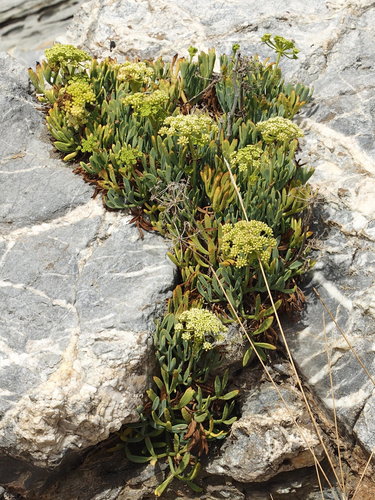
(c) Thomas Wrbka, some rights reserved (CC BY-NC)
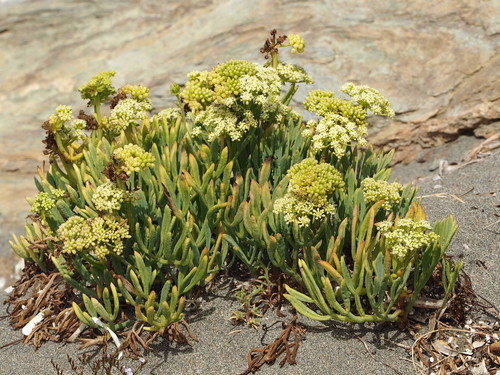
(c) Thomas Wrbka, some rights reserved (CC BY-NC)
What to Eat
Edible parts: Leaves, Flowers, Stems, Seeds, Spice
The leaves can be eaten raw or cooked. Their flavour is vaguely reminiscent of fennel but more bitter and brackish — one description characterises them as tasting like a mixture of celery and kerosene. They are used as a flavouring in salads and similar dishes. Young leaves gathered in spring, sprinkled with salt and boiled, make a very good pickle. The leaves are rich in vitamin C. The seed pods are also edible and are used to make a warm, aromatic pickle.
Where to Find It
It is a Mediterranean climate plant. It grows in sea cliffs in Britain. It occurs on coastal rocks and can be on sand or shingle. It needs well-drained to dry soil in the sun. It needs a warm sheltered position. It can grow in salty soils. It can grow in arid places. Melbourne Botanical Gardens.
Africa, Albania, Australia, Azores, Balkans, Bosnia, Britain, Bulgaria, Canary Islands, Central America, China,Crete, Croatia, Cyprus, Egypt, Europe, France, Germany, Greece, India, Ireland, Israel, Italy, Jamaica, Libya, Mediterranean, Middle East, Morocco, Netherlands, North Africa, North America, Portugal, Sicily, Slovenia, Spain, Turkey, Türkiye, Ukraine, USA, West Indies, Yugoslavia,
How to Identify
A perennial herb. It grows 15-45 cm high and wide. It is greyish and without hairs. It is branched. It has divided leaves. The lobes are narrow and fleshy and do not have teeth. The base sheaths the stem. The flowers are yellow. They occur in umbels 30-60 mm across. There are 8-36 rays. The fruit is oblong and 5-6 mm long. It is yellowish. It has thick ridges.
Nutrition Score: 24/100
| Part | Moisture | kJ | kcal | Protein | Vit A | Vit C | Iron | Zinc |
|---|---|---|---|---|---|---|---|---|
| Leaves | 87 | 84 | 20 | 2.2 | — | — | 2.3 | 0.5 |
How to Grow
Prefers a moist light sandy or gravelly soil, doing very well between stones or by a south-east facing wall. Requires a warm dry well-drained sunny position and shade from the midday sun. Requires saline conditions. Plants are best grown in moist salty soil or a very well-drained poor dry soil. When grown away from the coast, this plant requires a warm sheltered position and some protection in cold winters. At one time this plant was sometimes cultivated in the vegetable garden, though it is quite difficult to do this successfully. It is difficult to grow outside its natural habitat. Rock Samphire grows relatively quickly, establishing itself in sandy or rocky coastal environments and spreading over time. Rock Samphire is self-fertile. It is typically harvested in spring and early summer when the young leaves are tender. Rock Samphire generally flowers in summer.
Propagation: Sow seed in a cold frame in autumn, just barely covering it; germination usually takes 3–6 weeks at 15°C. Although one source notes that seed viability is short and it should be sown as soon as ripe, seed sown in April in a cold frame has also germinated well. When large enough to handle, prick seedlings into individual pots and plant out in early summer. The plant can also be propagated by division in spring.
Medicinal Uses
Rock samphire is little used in herbal medicine, though it is a good diuretic with potential as a treatment for obesity. It has a high vitamin C and mineral content and is thought to relieve flatulence and act as a digestive remedy. The young growing tips are carminative, depurative, digestive, and diuretic; they are gathered during active growth in spring and used fresh. The leaves have a reputation for aiding weight loss and are used in treating obesity, kidney complaints, and sluggishness. The essential oil acts as a digestive, with a few drops sprinkled on food.
Other Uses
Rock samphire can be used in coastal erosion control owing to its salt tolerance and ability to stabilise sandy soils, and it can be included in coastal restoration projects. An essential oil from the plant is used in perfumery. The flowers are rich in nectar and pollen and can attract bees and other pollinating insects. The leaves are edible for humans and may be consumed by some wildlife. The plant can provide habitat for invertebrates in coastal environments, and its structure may offer some overwintering sites for beneficial insects. Its strong, salty aroma may also help deter certain pests.
Wikipedia
Source ↗A perennial reaching 0.3 m tall and wide, growing quickly in coastal conditions. Flowers appear June to August with seed ripening August to October. The plant thrives in well-drained, sandy soils with low nutrient content and tolerates very alkaline and saline conditions. It requires full sun and handles maritime exposure well. Hardy to UK zone 6.
Other Information
It is sold in local markets. It is cultivated.
Notes
There is only one Crithmum species. It is high in Vitamin C.
Names & Synonyms
Criste marine, Denizmarulu, Fenoll mari, Finucchje ri mare, Kayakorugu, Kirtamo, Matar, Navadni koprc, Sea Fennel, Yedidalga
References (41)
- Bianchini, F., Corbetta, F., and Pistoia, M., 1975, Fruits of the Earth. Cassell. p 104
- Biscotti, N. & Pieroni, A., 2015, The hidden Mediterranean diet: wild vegetables traditionally gathered and consumed in the Gargano area, Apulia, SE Italy. Acta Societatis Botanicorum Poloniae 84 (3): 327-338
- Biscotti, N. et al, 2018, The traditional food use of wild vegetables in Apulia (Italy) in the light of Italian ethnobotanical literature. Italian Botanist 5:1-24
- Blamey, M and Grey-Wilson, C., 2005, Wild flowers of the Mediterranean. A & C Black London. p 157
- Bodkin, F., 1991, Encyclopedia Botanica. Cornstalk publishing, p 299
- Bremness, L., 1994, Herbs. Collins Eyewitness Handbooks. Harper Collins. p 161
- Brown, D., 2002, The Royal Horticultural Society encyclopedia of Herbs and their uses. DK Books. p 183
- Centofanti, T. & Banuelos, G., 2019, Practical uses of Halophytic Plants as Sources of Food and Fodder. CAB International. p 329
- Cerne, M., 1992, Wild Plants from Slovenia used as Vegetables. Acta Horticulturae 318
- Ciftcioglu, C. G., 2015, Sustainable wild-collection of medicinal and edible plants in Lefke region of North Cyprus. Agroforest Syst. Springer
- Della, A., et al, 2006, An ethnobotanical survey of wild edible plants of Paphos and Larnaca countryside of Cyprus. J. Ethnobiol. Ethnomed. 2:34
- Dogan, A., et al, 2014, A review of edible plants on the Turkish Apiaceae species. J. Fac. Pharm. Istanbul, 44(2) pp 251-262
- Dogan, Y., 2012, Traditionally used wild edible greens in the Aegean Region of Turkey. Acta Societatis Botanicorum Poloniae 81(4): 329-342
- Dolina, K. & Luczaj, L., 2014, Wild food plants used on the Dubrovnik coast (south-eastern Croatia) Acta Soc Bot Pol 83(3):175–181
- Ertug, F., 2004, Wild Edible Plants of the Bodrum Area. (Mugla, Turkey). Turk. J. Bot. 28 (2004): 161-174
- Ertug, F, Yenen Bitkiler. Resimli Türkiye Florası -I- Flora of Turkey - Ethnobotany supplement
- Facciola, S., 1998, Cornucopia 2: a Source Book of Edible Plants. Kampong Publications, 17
- Geraci, A., et al, 2018, The wild taxa utilized as vegetables in Sicily (Italy): a traditional component of the Mediterranean diet. Journal of Ethnobiology and Ethnomedicine (2018) 14:14
- Guil-Guerrero, J. L., et al, 2001, Edible Wild Plants. in Recent Progress in Medicinal Plants Vol. 8 Sci. Tech publishing, Texas
- Hadjichambis, A. C., et al, 2007, Wild and semi-domesticated food plant consumption in seven circum-Mediterranean areas. International Journal of Food Sciences and Nutrition. 2007, 1-32.
- Hedrick, U.P., 1919, (Ed.), Sturtevant's edible plants of the world. p 228
- Hibbert, M., 2002, The Aussie Plant Finder 2002, Florilegium. p 76
- Irving, M., 2009, The Forager Handbook, A Guide to the Edible Plants of Britain. Ebury Press p 119
- Joshi, A., et al, 2018, Halophytes of Thar Desert: Potential source of nutrition and feedstuff. International Journal of Bioassays 8.1 (2018) pp. 5674-5683
- Kiple, K.F. & Ornelas, K.C., (eds), 2000, The Cambridge World History of Food. CUP p 434, 1848
- Luczaj et al, 2013, Wild vegetable mixes sold in the markets of Dalmatia (southern Croatia). Journal of Ethnobiology and Ethnomedicine. 8:2
- Luczaj, L. et al, 2014, Wild Food Plants of Dalmatia (Croatia). in A. Pieroni, C. L. Quave (eds.), Ethnobotany and Biocultural Diversities in the Balkans, p 138
- Mabey, R., 1973, Food for Free. A Guide to the edible wild plants of Britain, Collins. p 111
- Mahklouf, M. H., 2019, Ethnobotanical Study of Edible Wild Plants in Libya. European Journal of Ecology. 5(2): 30-40
- Michael, P., 2007, Edible Wild Plants and Herbs. Grub Street. London. p 202
- Nassif, F., & Tanji, A., 2013, Gathered food plants in Morocco: The long forgotten species in Ethnobotanical Research. Life Science Leaflets 3:17-54
- Pasta, S., et al, 2020, An Updated Checklist of the Sicilian Native Edible Plants: Preserving the Traditional Ecological Knowledge of Century-Old Agro-Pastoral Landscapes. Frontiers in Plant Science. Volume 11|Article 388
- Plants for a Future database, The Field, Penpol, Lostwithiel, Cornwall, PL22 0NG, UK. http://www.scs.leeds.ac.uk/pfaf/
- Redzic, S. J., 2006, Wild Edible Plants and their Traditional Use in the Human Nutrition in Bosnia-Herzegovina. Ecology of Food and Nutrition, 45:189-232
- Royal Botanic Gardens, Kew (1999). Survey of Economic Plants for Arid and Semi-Arid Lands (SEPASAL) database. Published on the Internet; http://www.rbgkew.org.uk/ceb/sepasal/internet [Accessed 13th June 2011]
- Seidemann J., 2005, World Spice Plants. Economic Usage, Botany, Taxonomy. Springer. p 120
- Sinclair, V., 1992, The Floral Charm of Cyprus. Interworld Publications. p 119
- Sp. pl. 1:246. 1753
- Tardio, J., et al, Ethnobotanical review of wild edible plants in Spain. Botanical J. Linnean Soc. 152 (2006), 27-71
- Wiersema, J. H. & Leon, B., 2013, World Economic Plants. A Standard Reference CRC Press. 2nd Ed. p 210
- Zeven, A. C. & de West, J. M. J., 1982, Dictionary of cultivated plants and their regions of diversity. Wageningen. p 119