Crocus sativus
L.
Saffron, Saffron Crocus

(c) Юрий Данилевский (Yuriy Danilevsky), some rights reserved (CC BY), uploaded by Юрий Данилевский (Yuriy Danilevsky)
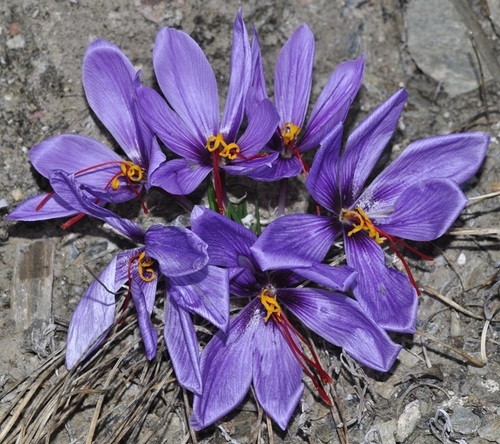
(c) faluke, some rights reserved (CC BY-NC)

(c) faluke, some rights reserved (CC BY-NC)
What to Eat
Edible parts: Root, Corm, Herb, Spice, Pollen, Leaves, Flowers
The flower styles are widely used as a flavouring and yellow colouring for foods including bread, soups, sauces, rice and puddings, and are an essential ingredient in dishes such as paella, bouillabaisse, risotto milanese and various other Italian recipes. They are extremely rich in riboflavin and are water soluble. Yields are very low — around 4,000 stigmas yield just 25g of saffron — making it the world's most expensive spice, requiring 150,000 flowers and 400 hours of work per kilogram. About 25kg of styles can be harvested per hectare. Only very small quantities are needed to impart colour and flavour, but because of the cost, saffron is frequently adulterated with cheaper substitutes such as marigold flowers and safflower. The styles are also used as a tea substitute. The corms can be eaten cooked, though they are reported to be toxic to young animals and this edibility should be treated with some caution.
Known Hazards
Where to Find It
A temperate plant. They require sun and good drainage. It needs a pH of 7. It is best in a good sandy loam. It is resistant to frost and drought. It suits hardiness zones 6-8. In Yunnan.
Africa, Algeria, Andorra, Asia, Australia, Austria, Azerbaijan, Brazil, Britain, Canada, Caucasus, China, Egypt, Europe, France, Georgia, Germany, Greece, Himalayas, India, Indonesia, Iraq, Iran, Israel, Italy, Japan, Malaysia, Mediterranean, Middle East, Morocco, Myanmar, Nepal, New Zealand, North Africa, North America, Pakistan, Palestine, SE Asia, Slovenia, South America, Spain, Switzerland, Taiwan, Tasmania, Turkey, Türkiye, West Africa,
How to Identify
A corm with grass-like leaves. It keeps growing from year to year. Under the ground it has bulb like corms. It grows 15-23 cm high. The leaves are long and grey-green like the leaves of chives. The flowers are small and mauve. The lily like flowers have stigmas which are bright orange. Each flower has 3 stigmas that are connected to the base of the flower by a fine pale thread. The flower stalks are leafless and the flower stalks occur singly. The dried stigmas are 10-18 mm long and dark red and thin. They are needle like at one end and trumpet shaped at the other.
Nutrition Score: 81/100
| Part | Moisture | kJ | kcal | Protein | Vit A | Vit C | Iron | Zinc |
|---|---|---|---|---|---|---|---|---|
| Flowers - dried | 11.9 | 1298 | 311 | 11.4 | 53 | 80.8 | 11.1 | 1.1 |
How to Grow
Prefers a well-drained sandy or loamy soil that is free from clay. Prefers a sunny position. Grows well on calcareous soils and on hot sheltered stony banks. Plants are very frost hardy. They also thrive in areas with poor summers, though they usually fail to flower in such conditions. Plants produce less saffron when grown on rich soils. They do not flower very freely in Britain. Saffron has been cultivated for over 4,000 years for the edible dye obtained from the flower stigmas. It was at one time commercially grown in Britain and the town Saffron Walden obtained its name because of this. There is at least one named form. 'Cashmirianus' comes from Kashmir and has large high quality corms. It yields about 27 kilos of rich orange stigmas per hectare. When inhaled near to, the flowers have a delicate perfume. Unlike most members of this genus, the flowers do not close of a night time or in dull weather. The flowers are only produced after hot, dry summers. Plants tend to move considerably from their original planting place because of their means of vegetative reproduction, it is therefore wise not to grow different species in close proximity. Any planting out is best done in late spring or early summer. Plants take 4 - 5 years to come into flowering from seed. Crocus sativus is self-fertile and can produce seeds without cross-pollination. Saffron is typically harvested in autumn when the flowers bloom. Crocus sativus flowers in the autumn, producing blooms shortly after the corms have been planted. Saffron has a moderate growth rate. The corms take about 6 to 8 weeks to establish before flowering, with full growth from planting to harvest generally taking around 6 months.
Propagation: This species is reportedly a sterile triploid and may not produce fertile seed. If seed is available, sow it as soon as ripe in a cold frame, or sow stored seed in spring in a cold frame. Germination takes 1–6 months at 18°c. Avoid transplanting seedlings in their first year unless overcrowded, but apply regular liquid feeds to prevent deficiency. Once plants die down, divide the small bulbs and plant 2–3 per 8cm pot. Grow on for two more years in a greenhouse or frame, then plant out into permanent positions when dormant in late summer. Plants take 3 years to flower from seed. Alternatively, divide clumps in late summer after the plant has died down and plant bulbs directly into permanent positions.
Medicinal Uses
Saffron has a long and well-documented history of medicinal use, though it is little employed today as cheaper and more effective alternatives exist. The flower styles and stigmas are the parts used; their small, fiddly nature makes them expensive to harvest and they are frequently adulterated. The styles and stigmas are anodyne, antispasmodic, aphrodisiac, appetizer, carminative, diaphoretic, emmenagogue, expectorant, sedative and stimulant. They are used as a diaphoretic for children, to treat chronic uterine haemorrhage in adults, to induce menstruation, relieve period pains, and calm indigestion and colic. The stigmas also yield a dental analgesic. Styles are harvested in autumn when the plant is in flower and dried for later use; they do not store well and should be used within 12 months. Use with caution — large doses can be narcotic, and quantities of 10g or more can cause abortion.
Other Uses
A yellow dye from the stigmas has been used for centuries to colour cloth and is the traditional colouring for the robes of Indian swamis. A blue or green dye can be obtained from the petals. Saffron flowers are attractive to pollinators and produce nectar, making them useful for drawing bees and other beneficial insects.
Wikipedia
Source ↗Crocus sativus, commonly known as saffron crocus or autumn crocus, is a species of flowering plant in the iris family Iridaceae. A cormous autumn-flowering cultivated perennial, unknown in the wild, it is best known for the culinary use of its floral stigmas as the spice saffron. Human cultivation of saffron crocus and the trade and use of saffron have endured for more than 3,500 years and span different cultures, continents, and civilizations.
Production
The flowers are picked and the threadlike stamens removed. The flowers are then dried before using. Over 5,000 stigmas (1,700 flowers) are needed to give 25 g of dried saffron. (Or 200,000 flowers for a kg of saffron)
Other Information
It is cultivated.
Notes
There are about 80 Crocus species. It is a sterile triploid plant. It is mentioned in the Bible. Song of Songs 4:14. It has anticancer properties.
Names & Synonyms
Fan-hung-hua, Gon-ga-man, Jafran, Kesar, Kesara, Kesari, Keshar, Keshara, Koma-koma, Kong, Kungumapu, Kunkumakesari, Kunkumapuvu, Pravi žafran, Saffraan, Za'faran, Zafferano, Zaffran, Zafran, Zaprana
References (38)
- Ali-Shtayeh, M. S., et al, 2008, Traditional knowledge of wild edible plants used in Palestine (Northern West Bank): A comparative study. J Ethnobiol Ethnomed. 4: 13
- Ambasta, S.P. (Ed.), 2000, The Useful Plants of India. CSIR India. p 146
- Bianchini, F., Corbetta, F., and Pistoia, M., 1975, Fruits of the Earth. Cassell. p 214
- Blamey, M and Grey-Wilson, C., 2005, Wild flowers of the Mediterranean. A & C Black London. p 498
- Bodkin, F., 1991, Encyclopedia Botanica. Cornstalk publishing, p 300
- Brickell, C. (Ed.), 1999, The Royal Horticultural Society A-Z Encyclopedia of Garden Plants. Convent Garden Books. p 318
- Brown, D., 2002, The Royal Horticultural Society encyclopedia of Herbs and their uses. DK Books. p 183
- Bussman, R. W., et al, 2021, Unity in diversity—food plants and fungi of Sakartvelo (Republic of Georgia), Caucasus. Journal of Ethnobiology and Ethnomedicine (2021) 17:72 p 9
- Cundall, P., (ed.), 2004, Gardening Australia: flora: the gardener's bible. ABC Books. p 436
- D'Agostino, N., et al, 2007, An EST database from saffron stigmas. BMC Plant Biology, 7:53
- Ertug, F, Yenen Bitkiler. Resimli Türkiye Florası -I- Flora of Turkey - Ethnobotany supplement
- Esperanca, M. J., 1988. Surviving in the wild. A glance at the wild plants and their uses. Vol. 2. p 188
- Everest, A. & Ozturk, E., 2005, Focusing on the ethnobotanical uses of plants in Mersin and Adana provinces (Turkey). Journal of Ethnobiology and Ethnomedicine 1:6
- Facciola, S., 1998, Cornucopia 2: a Source Book of Edible Plants. Kampong Publications, p 122
- Flora of Pakistan. www.eFloras.org
- Hedrick, U.P., 1919, (Ed.), Sturtevant's edible plants of the world. p 228
- Hemphill, I, 2002, Spice Notes. Macmillan. p 337
- Heywood, V.H., Brummitt, R.K., Culham, A., and Seberg, O., 2007, Flowering Plant Families of the World. Royal Botanical Gardens, Kew. p 3725
- Hibbert, M., 2002, The Aussie Plant Finder 2002, Florilegium. p 76
- Jacobsen, A. L., February 2013: edible Crocus www.arthurleej.com/plant of the month.html
- Kintzios, S. E., 2006, Terrestrial Plant-Derived Anticancer Agents and Plant Species Used in Anticancer research. Critical Reviews in Plant Sciences. 25: pp 79-113
- Kiple, K.F. & Ornelas, K.C., (eds), 2000, The Cambridge World History of Food. CUP p 434
- Kybal, J., 1980, Herbs and Spices, A Hamlyn Colour Guide, Hamlyn Sydney p 86
- Lim, T. K., 2015, Edible Medicinal and Non Medicinal Plants. Volume 9, Modified Stems, Roots, Bulbs. Springer p 28
- Liu, Yi-tao, & Long, Chun-Lin, 2002, Studies on Edible Flowers Consumed by Ethnic Groups in Yunnan. Acta Botanica Yunnanica. 24(1):41-56
- Marinelli, J. (Ed), 2004, Plant. DK. p 231
- Morley, B. & Everard, B., 1970, Wild Flowers of the World. Ebury press. Plate 42
- Mulherin, J., 1994, Spices and natural flavourings. Tiger Books, London. p 79
- Plants for a Future database, The Field, Penpol, Lostwithiel, Cornwall, PL22 0NG, UK. http://www.scs.leeds.ac.uk/pfaf/
- PROSEA handbook Volume 13 Spices. p 275
- Seidemann J., 2005, World Spice Plants. Economic Usage, Botany, Taxonomy. Springer. p 122
- Solomon, C., 2001, Encyclopedia of Asian Food. New Holland. p 317
- Sp. pl. 1:36. 1753
- Tyagi, R. K., et al, 2004, Conservation of Spices Germplasm in India. Indian J. Plant Genet. Resour. 17(3): 163-174
- van Wyk, B., 2005, Food Plants of the World. An illustrated guide. Timber press. p 155
- Wiersema, J. H. & Leon, B., 2013, World Economic Plants. A Standard Reference CRC Press. 2nd Ed. p 211
- World Checklist of Useful Plant Species 2020. Royal Botanic Gardens, Kew
- Zeven, A. C. & de West, J. M. J., 1982, Dictionary of cultivated plants and their regions of diversity. Wageningen. p 94, 112


