Codon royenii
L.
iNaturalist · cc-by
(c) Kevin Murray, some rights reserved (CC BY), uploaded by Kevin Murray
(c) Kevin Murray, some rights reserved (CC BY), uploaded by Kevin Murray

iNaturalist · cc-by-nc
(c) Bernhard Fischer, some rights reserved (CC BY-NC), uploaded by Bernhard Fischer
(c) Bernhard Fischer, some rights reserved (CC BY-NC), uploaded by Bernhard Fischer
iNaturalist · cc-by-sa
(c) Tony Rebelo, some rights reserved (CC BY-SA), uploaded by Tony Rebelo
(c) Tony Rebelo, some rights reserved (CC BY-SA), uploaded by Tony Rebelo
What to Eat
Edible parts: Fruit, Nectar
The nectar is eaten as a snack and the fruit is consumed.
Where to Find It
It is a subtropical plant. It grows on dry stony slopes.
Africa, Namibia, South Africa, Southern Africa,
Countries: Angola, Burkina Faso, Burundi, Benin, Botswana, Congo (DRC), Central African Republic, Congo (Republic), Cote d'Ivoire, Cameroon, Cape Verde, Djibouti, Algeria, Egypt, Eritrea, Ethiopia, Gabon, Ghana, Gambia, Guinea, Equatorial Guinea, Guinea-Bissau, Kenya, Comoros, Liberia, Lesotho, Libya, Morocco, Madagascar, Mali, Mauritania, Mauritius, Malawi, Mozambique, Namibia, Niger, Nigeria, Rwanda, Seychelles, Sudan, Sierra Leone, Senegal, Somalia, South Sudan, Sao Tome & Principe, Eswatini, Chad, Togo, Tunisia, Tanzania, Uganda, South Africa, Zambia, Zimbabwe
How to Identify
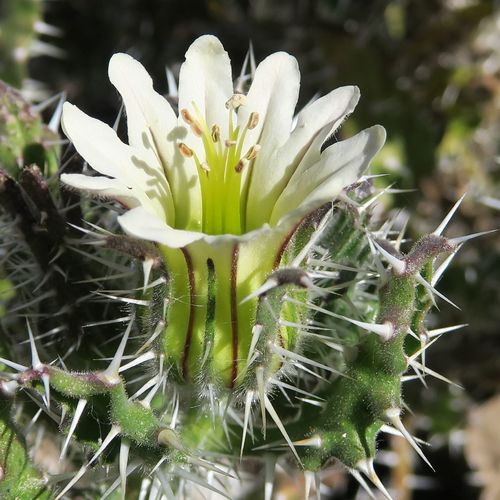
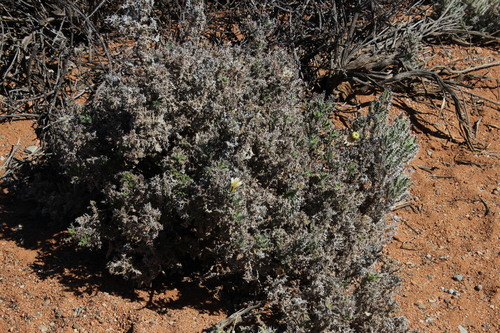
A small shrub. It is softly woody and has white prickles. It grows 1.5 m tall. The leaf stalk and leaves have white prickles. The leaves are oval to wedge shaped. The flowers are cream coloured with purple stripes. The fruit is a capsule with lumps.
Wikipedia
Source ↗Codon royenii is a species of flowering plant in the genus Codon. It is native to Namibia and the Northern Cape Province of South Africa. It is also known by the names honey bush or white nectarcup, or in Afrikaans as heuningbos and suikerkelk (meaning sugar cup).
Names & Synonyms
Codon aculeatum Gaertn.
References (2)
- Ruiters-Welcome, A. K., 2019, Food plants of southern Africa. Ph.D. thesis. Univ. of Johannesburg p 38
- Welcome, A. K. & Van Wyk, B.-E., 2019, An inventory and analysis of the food plants of southern Africa. South African Journal of Botany 122 (2019) 136–179


