Cyperus capensis
(Steud.) Endl.
CyperaceaeRoots

iNaturalist · cc-by-sa
(c) Nicola van Berkel, some rights reserved (CC BY-SA), uploaded by Nicola van Berkel
(c) Nicola van Berkel, some rights reserved (CC BY-SA), uploaded by Nicola van Berkel

iNaturalist · cc-by-nc
(c) Marie Delport, some rights reserved (CC BY-NC)
(c) Marie Delport, some rights reserved (CC BY-NC)
What to Eat
Edible parts: Root
The roots are eaten as a vegetable.
Where to Find It
It is a subtropical plant. It grows on grassy slopes.
Africa, South Africa, Southern Africa,
Countries: Angola, Burkina Faso, Burundi, Benin, Botswana, Congo (DRC), Central African Republic, Congo (Republic), Cote d'Ivoire, Cameroon, Cape Verde, Djibouti, Algeria, Egypt, Eritrea, Ethiopia, Gabon, Ghana, Gambia, Guinea, Equatorial Guinea, Guinea-Bissau, Kenya, Comoros, Liberia, Lesotho, Libya, Morocco, Madagascar, Mali, Mauritania, Mauritius, Malawi, Mozambique, Namibia, Niger, Nigeria, Rwanda, Seychelles, Sudan, Sierra Leone, Senegal, Somalia, South Sudan, Sao Tome & Principe, Eswatini, Chad, Togo, Tunisia, Tanzania, Uganda, South Africa, Zambia, Zimbabwe
How to Identify
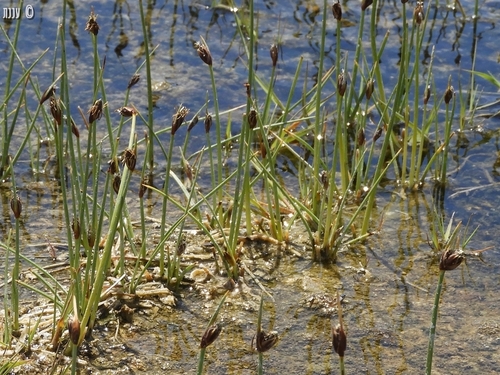
A herb that keeps growing from year to year. It grows 20-60 cm tall. It has a narrow oval bulb like root. The flowers are in a spike like head. These are green.
Wikipedia
Source ↗Cyperus capensis is a species of sedge that is native to South Africa, Mozambique, and Eswatini in southern Africa.
Names & Synonyms
Kyllinga capensis Steud.Mariscus capensis (Steud.) Schrad.and others
References (2)
- Ruiters-Welcome, A. K., 2019, Food plants of southern Africa. Ph.D. thesis. Univ. of Johannesburg p 51
- Welcome, A. K. & Van Wyk, B.-E., 2019, An inventory and analysis of the food plants of southern Africa. South African Journal of Botany 122 (2019) 136–179
More from Cyperaceae

Actinoscirpus grossus
Giant bulrush, Greater club-rush

Actinoscirpus grossus var. kysoor
Amphiscirpus nevadensis
Nevada bulrush, Great basin bulrush

Bolboschoenus caldwellii
Sea club rush, Marsh club rush, Seaside bulrush

Bolboschoenus fluviatilis
Marsh club rush, River bulrush, Kukuraho, Purua grass

Bolboschoenus glaucus