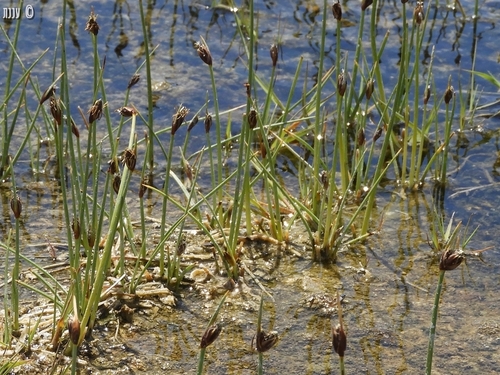
Cyperus marginatus
Thunb.

(c) Jane Trembath, some rights reserved (CC BY-NC), uploaded by Jane Trembath
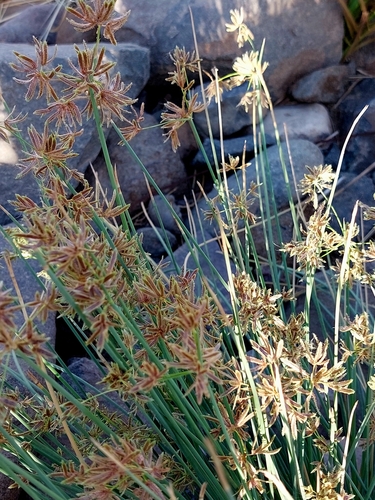
(c) Bart Wursten, some rights reserved (CC BY-NC)
What to Eat
Edible parts: Stem
We have no specific information for this species, but it is said that the inner base of the young stems of all species in this genus can be eaten raw, and make an excellent survival food in times of need.
Where to Find It
It is a subtropical plant. It grows on the edges of watercourses in rocky crevices.
Africa, Angola, Kenya, South Africa, Southern Africa,
How to Identify
A sedge. It keeps growing from year to year. It grows 60 cm tall. Usually it does not have leaves. It forms tufts. The spikes are brown with pale edges.
How to Grow
Requires a sunny position.
Medicinal Uses
Warmed portions of the root are placed as a poultice around the throat of someone with a sore throat or mumps.
Other Uses
The stems are used for thatching. The stems are used in weaving for making sleeping mats, grinding mats and various handicrafts. The stems have also been used for making baskets. When growing wild, the plant is considered an indicator of the presence of water close to the soil surface.
Wikipedia
Source ↗Cyperus marginatus is a species of sedge that is native to Angola, Namibia, Botswana, South Africa, Lesotho, and Eswatini in southern Africa, and Kenya in eastern Africa.
Names & Synonyms
References (2)
- Ruiters-Welcome, A. K., 2019, Food plants of southern Africa. Ph.D. thesis. Univ. of Johannesburg p 51
- Welcome, A. K. & Van Wyk, B.-E., 2019, An inventory and analysis of the food plants of southern Africa. South African Journal of Botany 122 (2019) 136–179
More from Cyperaceae