Cryptotaenia canadensis
(L.) A.DC.
Japanese cryptotaenia, Japanese parsley
(c) thesoulflowers, some rights reserved (CC BY-NC)

(c) Douglas Goldman, some rights reserved (CC BY-SA), uploaded by Douglas Goldman

(c) Kelly Fuerstenberg, some rights reserved (CC BY-NC), uploaded by Kelly Fuerstenberg
What to Eat
Edible parts: Flowers, Leaves, Root, Stem, Seeds, Spice
Young leaves, stems and flowers can be eaten raw or cooked — used as a potherb or added to salads, with a flavour somewhat reminiscent of celery. The root is edible cooked. Seeds are used as a flavouring for cakes, breads and biscuits.
Where to Find It
It is a temperate plant. It suits cooled places. It withstands frosts well. It can grow in shade. It can be grown in the lowlands in Indonesia. It suits hardiness zones 3-9.
Asia, Australia, Canada, China, Hawaii, Indonesia, Japan, North America*, Pacific, SE Asia, Slovenia, USA,
How to Identify
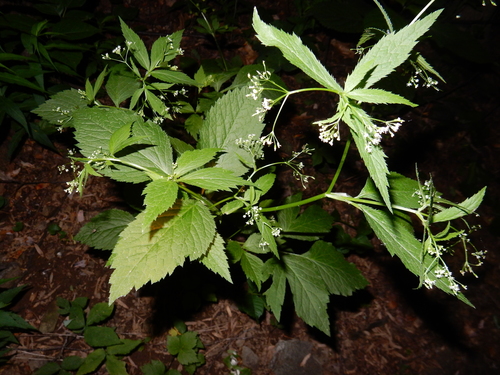
A perennial normally grown as an annual. It has a strong taproot. It grows 90 cm high and spreads 50-70 cm wide. The leaves have leaflets along the stalk. The leaves are 10 cm long and the leaflets are sword shaped and have teeth. The flowers are white and in loose heads.
How to Grow
Plants can be grown from seed or by root division.
Propagation: Sow seed in a greenhouse in April. Germination is usually rapid; prick out seedlings into individual pots when large enough to handle and plant out in early summer. The ideal germination temperature is around 25°c, though seed will germinate at higher and lower temperatures. Seed can also be sown in early autumn. Divide plants in spring or autumn.
Medicinal Uses
None known
Other Uses
None known
Wikipedia
Source ↗Cryptotaenia canadensis, the Canadian honewort, is a perennial plant species native to the eastern United States and eastern Canada. Its young leaves and stems can be used as a boiled green or seasoning similar to parsley. The parsniplike roots can be cooked and eaten.
Other Information
It is a cultivated food plant.
Notes
There are 6 Cryptotaenia species. Chemical composition: Protein = 2.3%. Fat = 0.23%. Carbohydrate = 4.4%. Ash = 2.1%. Contains a small amount of fragrant oil.
Names & Synonyms
Honewort white chervil, Honewort, Japanese honewort, Japonski petršilj, Mitsuba, Salderi Jepang, Trefoil, Wild chervil
References (24)
- Altschul, S.V.R., 1973, Drugs and Foods from Little-known Plants. Notes in Harvard University Herbaria. Harvard Univ. Press. Massachusetts. no. 3151
- Arora, R. K., 2014, Diversity in Underutilized Plant Species - An Asia-Pacific Perspective. Bioversity International. p 39
- Brown, D., 2002, The Royal Horticultural Society encyclopedia of Herbs and their uses. DK Books. p 184
- Coll. mem. 5:42. 1829
- Crawford, M., 2012, How to grow Perennial Vegetables. Green Books. p 134
- Cundall, P., (ed.), 2004, Gardening Australia: flora: the gardener's bible. ABC Books. p 440
- Duke, J.A., 1992, Handbook of Edible Weeds. CRC Press. p 80
- Facciola, S., 1998, Cornucopia 2: a Source Book of Edible Plants. Kampong Publications, 17
- Hedrick, U.P., 1919, (Ed.), Sturtevant's edible plants of the world. p 229
- Hibbert, M., 2002, The Aussie Plant Finder 2002, Florilegium. p 77
- Jackes, D. A., Edible Forest Gardens
- Kiple, K.F. & Ornelas, K.C., (eds), 2000, The Cambridge World History of Food. CUP p 1786
- Lim, T. K., 2015, Edible Medicinal and Non Medicinal Plants. Volume 9, Modified Stems, Roots, Bulbs. Springer p 29
- Martin, F.W. & Ruberte, R.M., 1979, Edible Leaves of the Tropics. Antillian College Press, Mayaguez, Puerto Rico. p 222
- Ochse, J. J. et al, 1931, Vegetables of the Dutch East Indies. Asher reprint. p 707
- Plants for a Future database, The Field, Penpol, Lostwithiel, Cornwall, PL22 0NG, UK. http://www.scs.leeds.ac.uk/pfaf/
- PROSEA handbook Volume 13 Spices. p 276
- Seidemann J., 2005, World Spice Plants. Economic Usage, Botany, Taxonomy. Springer. p 124
- Staples, G.W. and Herbst, D.R., 2005, A tropical Garden Flora. Bishop Museum Press, Honolulu, Hawaii. p 114
- Tozer, F., 2007, The Uses of Wild Plants. Green Man Publishing. p 73
- USDA, ARS, National Genetic Resources Program. Germplasm Resources Information Network - (GRIN). [Online Database] National Germplasm Resources Laboratory, Beltsville, Maryland. Available: www.ars-grin.gov/cgi-bin/npgs/html/econ.pl (10 April 2000)
- Wiersema, J. H. & Leon, B., 2013, World Economic Plants. A Standard Reference CRC Press. 2nd Ed. p 215
- Woodward, P., 2000, Asian Herbs and Vegetables. Hyland House. p 59
- World Checklist of Useful Plant Species 2020. Royal Botanic Gardens, Kew