Maesa tetrandra
(Roxb.) A. DC.
Four-stamen maesa

President and Fellows of Harvard College

President and Fellows of Harvard College

President and Fellows of Harvard College
What to Eat
Edible parts: Fruit
The fleshy fruit is edible.
Where to Find It
It is a tropical plant. It grows up to 1,230 m above sea level.
Asia, India, Indonesia, Myanmar, Pacific, Palau, Papua, Papua New Guinea, PNG, SE Asia,
How to Identify
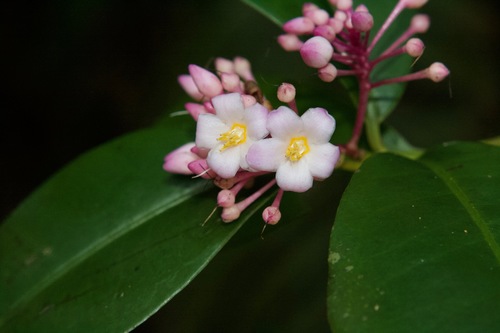
A shrub or small tree. It grows 6 m tall. Young parts have rusty coloured hairs. The leaves are narrowly oval and 5-10 cm long by 3-6.5 cm wide. The flowers are in the axils of leaves. The flowers mature from the bottom up. The flowers have 4 parts. The fruit is round and fleshy. It is whitish and 2.5-3 cm across. The seeds are black.
Medicinal Uses
The crushed roots are used as a treatment for fevers. A decoction of the leaves and shoots are used as a treatment for measles. The pharmacological potential of this plant is unexplored as of yet, but one can reasonably expect quinones to be responsible for the antiviral property of the plant.
Notes
The name is ambiguous.
Names & Synonyms
References (2)
- Costion, C. A. & Uttridge, T. M. A., 2014, Maesa tetrandra (Primulaceae) in Palau: An Introduced Species Mistaken for a Single-Island Endemic. Pacific Science (2014), vol. 68, no. 1:111–116
- World Checklist of Useful Plant Species 2020. Royal Botanic Gardens, Kew