Moraea bituminosa
(L.f.) Ker. Gawl.
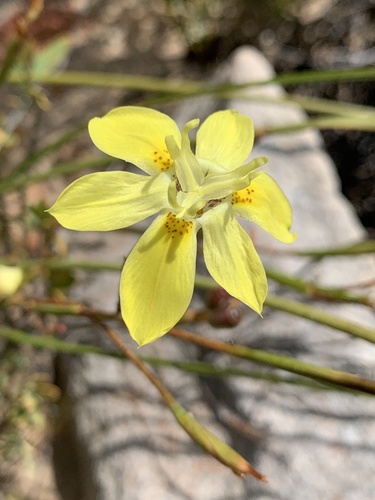
(c) Matthew Fainman, some rights reserved (CC BY), uploaded by Matthew Fainman

(c) Dave Richardson, some rights reserved (CC BY), uploaded by Dave Richardson
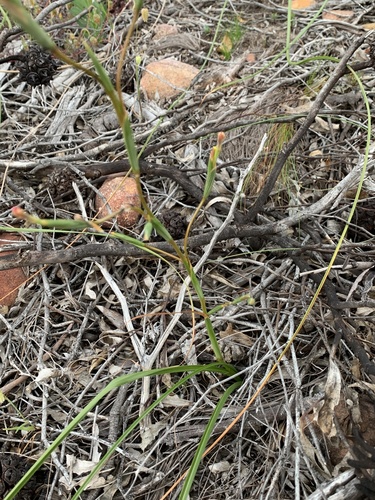
(c) Matthew Fainman, some rights reserved (CC BY), uploaded by Matthew Fainman
What to Eat
Edible parts: Corm, Bulb, Root
The corm or bulb is eaten as a snack or cooked as a vegetable.
Where to Find It
It is a subtropical plant.
Africa, South Africa*, Southern Africa,
How to Identify
A corm or bulb plant. It grows 20-50 cm tall. There are 2 or 3 narrow leaves. They have a channel and are trailing. The flowers are large and yellow.
Wikipedia
Source ↗Moraea bituminosa is a species of the genus Moraea in family Iridaceae. It is a cormous geophyte 25 – 30 cm high with two leaves. The plant is sticky to the touch. Flowers are yellow with deep yellow nectar guides. The outer tepals are 22–32 mm long and inner tepals are 20 to 29 mm long. It flowers from October to December with flowers opening in the afternoon. It is endemic to the Western Cape, from Bredasdorp in the south-east to Wellington and Tulbagh in the north, on stony sandstone slopes. It was first described by Carolus Linnaeus the Younger in 1782 as Iris bituminosa. In 1805, John Bellenden Ker Gawler moved this species to its current name, Moraea bituminosa.
Names & Synonyms
References (2)
- Ruiters-Welcome, A. K., 2019, Food plants of southern Africa. Ph.D. thesis. Univ. of Johannesburg p 67
- Welcome, A. K. & Van Wyk, B.-E., 2019, An inventory and analysis of the food plants of southern Africa. South African Journal of Botany 122 (2019) 136–179


