Faurea saligna
Harv.
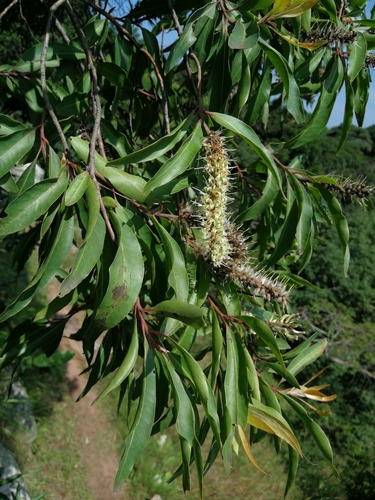
(c) Craig Peter, some rights reserved (CC BY-NC), uploaded by Craig Peter

(c) Bart Wursten, some rights reserved (CC BY-NC)
What to Eat
Edible parts: Flower - nectar - bees
The flower nectar is used by bees.
Where to Find It
It is a subtropical plant.
Africa, Congo DR, East Africa, Eswatini, Kenya, Mozambique, South Africa, Southern Africa, Swaziland, Tanzania, Zimbabwe,
How to Identify
A tree. It grows 17 m tall. The young branches are light brown. The leaves are narrowly sword shaped. They are 16 cm long and 3-3.5 cm wide. The leaf stalk is 1.5 cm long. The flower heads are in slender spikes 2-3 cm across and 12-15 cm long. The flowers are 12 mm long. They are covered with grey hairs.
How to Grow
A plant of the drier areas of tropical Africa, where it is found at elevations from 700 - 2,000 metres or more. It grows best in areas where annual daytime temperatures are within the range 20 - 28°c, but can tolerate 16 - 35°c. It prefers a mean annual rainfall in the range 500 - 1,000mm, but tolerates 400 - 1,500mm. Requires a sunny position. It is usually found on sandy or red loam soils and on stony slopes in the wild. Prefers a pH in the range 5.5 - 7, tolerating 5 - 7.5. Established plants are drought tolerant. Plants have a thick bark and can withstand moderate burning, but do not survive fierce grass fires. The flowers are attractive to bees, who readily collect the nectar to produce a strongly flavoured honey with a rather musty aroma.
Medicinal Uses
The bark is boiled in broth and taken as a tonic. The roots are boiled and the liquid drunk as a remedy for diarrhoea and indigestion.
Other Uses
A red dye is obtained by soaking the wood in water. The bark contains tannins. The wood is strong, durable, of medium weight, brittle, and pale yellow, red or dark brown. It is beautifully figured, handsomely coarse grained, polishes well, does not warp or shrink and can be worked green, but suffers from gum pockets (cracks in the wood filled with bright yellow gum). It is easy to work and excellent for furniture, cabinet making, internal construction, joinery, doors, wagons, poles, posts, water wheels, panelling and as general-purpose timber. It is not attacked by borers or termites. The wood makes good firewood and charcoal. Trees can be planted as windbreaks.
Wikipedia
Source ↗Faurea saligna is a graceful, semi-deciduous tree in the family Proteaceae. It grows to about 10 metres (33 ft), or up to 20 metres (66 ft) under forest conditions. Found from tropical Africa south to the Transvaal, Swaziland and Natal, often in large communities on sandy soil and along stream beds. Its dark-grey to black bark is rough and deeply fissured, while the narrow drooping leaves are reminiscent of a willow (saligna meaning Salix-like). The timber was much-prized by the Voortrekkers for furniture and they named it Transvaal Boekenhout for the timber's resemblance to that of the European Beech. There are some 15 species of Faurea occurring in Africa and Madagascar. William Henry Harvey named the genus after William Caldwell Faure (1822-1844), a young soldier and enthusiastic botanist who was killed in India, and was the son of Cape Town Dutch Reformed minister Abraham Faure. Faure had accompanied Harvey on numerous botanising excursions, and had left the Cape for India in 1844 having received a commission in the East India Company's military service. He contracted cholera on arriving and was fortunate to recover. A few months later and in the company of a few fellow soldiers, he was shot by a sniper while crossing a ravine in a patch of forest, on the way to rejoining his regiment. He died after some twelve hours.
Names & Synonyms
Malkat
References (4)
- Ruiters-Welcome, A. K., 2019, Food plants of southern Africa. Ph.D. thesis. Univ. of Johannesburg p 93
- Termote, C., et al, 2014, Assessing the potential of wild foods to reduce the cost of a nutritionally adequate diet: An example from eastern Baringo District, Kenya. Food and Nutrition Bulletin, vol. 35, no. 4
- Welcome, A. K. & Van Wyk, B.-E., 2019, An inventory and analysis of the food plants of southern Africa. South African Journal of Botany 122 (2019) 136–179
- World Checklist of Useful Plant Species 2020. Royal Botanic Gardens, Kew
More from Proteaceae


