Protea burchellii
Stapf
ProteaceaeFlowers

iNaturalist · cc-by-nc
(c) Carina Lochner, some rights reserved (CC BY-NC), uploaded by Carina Lochner
(c) Carina Lochner, some rights reserved (CC BY-NC), uploaded by Carina Lochner
iNaturalist · cc-by-nc
(c) Dewald du Plessis, some rights reserved (CC BY-NC)
(c) Dewald du Plessis, some rights reserved (CC BY-NC)
iNaturalist · cc-by-nc
(c) Dewald du Plessis, some rights reserved (CC BY-NC)
(c) Dewald du Plessis, some rights reserved (CC BY-NC)
What to Eat
Edible parts: Nectar
The flower nectar is eaten fresh as a snack and can be used to make syrup.
Where to Find It
It is a subtropical plant.
Africa, South Africa*, Southern Africa,
Countries: Angola, Burkina Faso, Burundi, Benin, Botswana, Congo (DRC), Central African Republic, Congo (Republic), Cote d'Ivoire, Cameroon, Cape Verde, Djibouti, Algeria, Egypt, Eritrea, Ethiopia, Gabon, Ghana, Gambia, Guinea, Equatorial Guinea, Guinea-Bissau, Kenya, Comoros, Liberia, Lesotho, Libya, Morocco, Madagascar, Mali, Mauritania, Mauritius, Malawi, Mozambique, Namibia, Niger, Nigeria, Rwanda, Seychelles, Sudan, Sierra Leone, Senegal, Somalia, South Sudan, Sao Tome & Principe, Eswatini, Chad, Togo, Tunisia, Tanzania, Uganda, South Africa, Zambia, Zimbabwe
How to Identify
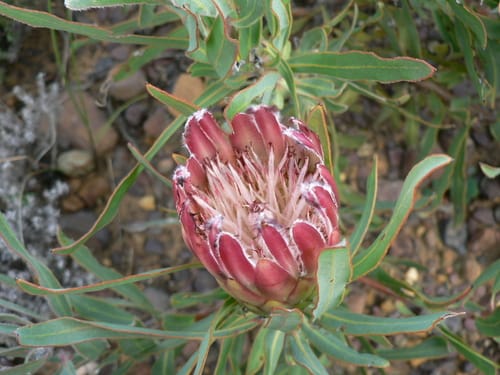
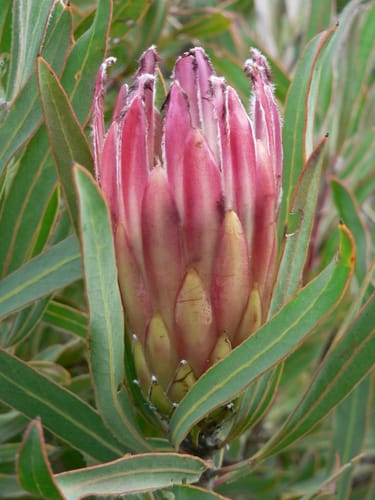
A shrub. It grows 2 m tall. It can spread to 3 m across. It has a single main stem. The branches are 5-8 mm across. The leaves are narrow and 7-17 cm long by 1-2 cm wide. The flowering shoots are 9-11 cm long by 5-7 cm wide.
Wikipedia
Source ↗Protea burchellii, also known as Burchell's sugarbush, is a flowering shrub in the genus Protea, which is endemic to the southwestern Cape Region of South Africa. The shrub is known by the vernacular name of blinksuikerbos in the Afrikaans language.
Names & Synonyms
Protea pulchra Rycroft
References (2)
- Ruiters-Welcome, A. K., 2019, Food plants of southern Africa. Ph.D. thesis. Univ. of Johannesburg p 93
- Welcome, A. K. & Van Wyk, B.-E., 2019, An inventory and analysis of the food plants of southern Africa. South African Journal of Botany 122 (2019) 136–179
More from Proteaceae

Athertonia diversifolia
Atherton oak, White Oak, Creamy silky oak, Atherton nut

Banksia aemula
Wallum banksia

Banksia ashbyi
Ashby’s Banksia

Banksia attenuata
Candlestick Banksia, Coast Banksia, Slender Banksia

Banksia candolleana
Propeller Banksia

Banksia dentata
Bottle brush, Swamp Banksia, Tropical Banksia, Northern Banksia